

1. What Are Lattice Steel Columns?
Lattice steel columns are built-up structural compression members consisting of two or more individual steel sections connected by a system of lacing members or batten plates. Unlike conventional solid-web columns made from a single H-beam or welded H-section, lattice columns use separated longitudinal components to form a larger overall cross-section.
This structural arrangement allows engineers to develop a large cross-sectional dimension without using one extremely heavy solid-web section. It is particularly useful for heavy industrial buildings, large-span workshops, crane-supporting structures and other projects requiring substantial axial load capacity and structural stiffness. Typical applications of lattice steel columns include:
- Heavy industrial workshops
- Steelmaking and metallurgical plants
- Large-span industrial buildings
- Crane-supporting structures
- Heavy equipment support structures
- High-load industrial column systems
It is important to understand that lattice columns are not automatically stronger than H-section columns. Their suitability depends on the overall structural design, member slenderness, connection configuration, loading conditions and stability calculations.
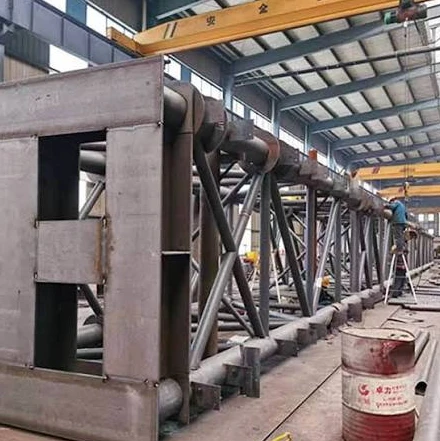
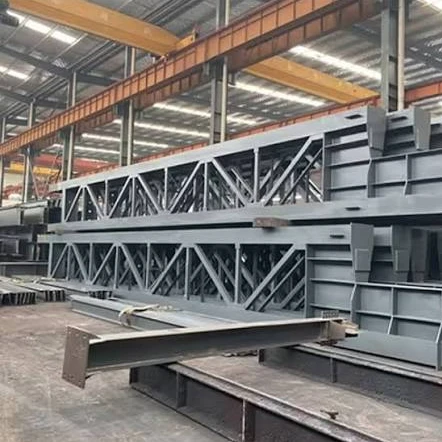
Main Components of a Lattice Steel Column
A lattice steel column generally consists of three main structural components: chord members, lacing members and transverse diaphragms or batten systems.
1 Chord Members
Chord members are the main longitudinal components of a lattice steel column. They are usually manufactured from H-sections, channels, angles or fabricated steel sections.
Their primary function is to carry axial compression and, depending on the structural arrangement, resist bending effects caused by eccentric loading or overall column moments.
The spacing between chord members is an important design parameter because it affects the overall cross-sectional dimensions, bending stiffness and structural stability of the built-up column.
2 Lacing Members
Lacing members are diagonal steel components installed between the chord members. They are commonly fabricated from angle sections or other suitable steel profiles.
Their primary function is to connect the individual chord members and transfer shear forces between them. This allows the separate components to work together as one built-up compression member.
The arrangement of lacing members also affects the effective slenderness and stability behavior of the individual chord members. Therefore, their section size, spacing, connection details and diagonal angles must be determined through structural design.
2.3 Diaphragms
Diaphragms are transverse structural components installed between the different parts of a lattice column. They can be designed as diaphragm plates or fabricated diaphragm frames.
Unlike ordinary diagonal lacing members, diaphragms provide transverse restraint and help maintain the integrity of the column cross-section.
They are particularly important at locations subjected to significant horizontal forces, concentrated loads or other conditions requiring additional transverse connection.
Lacing Members vs. Additional Lacing Members vs. Diaphragms
These three terms are related to the connection and stability of lattice steel columns, but they do not represent the same structural component.
| Component | Structural arrangement | Main function |
|---|---|---|
| Lacing Members | Diagonal members between chord members | Transfer shear and connect individual chord members |
| Additional Lacing Members | Extra lacing members at designated locations | Provide additional local restraint or load transfer |
| Diaphragms | Transverse plates or frames | Maintain cross-sectional integrity and transfer transverse forces |
| Batten Plates | Transverse plates connecting chord members | Connect chord members in a batten-type built-up column |
Why Are Additional Lacing Members Needed in Heavy Steel Columns?
In heavy industrial buildings, lattice steel columns may be subjected to substantial vertical loads, horizontal forces and bending moments. These actions can be transferred through crane runway beams, brackets, equipment supports and other structural connections.
For example, a crane runway system may introduce vertical wheel loads and horizontal forces generated during crane acceleration, braking and operation. These forces can create additional internal forces in the column and increase the demand on local connections.
.
When the original lacing arrangement does not provide sufficient local restraint or satisfy the required force-transfer conditions, additional lacing members or other strengthening details may be considered.
Main functions of additional lacing members
1. Improving local restraint
Additional lacing members can help restrain relative movement between chord members at designated locations, depending on the structural configuration.
2. Improving force transfer
Where concentrated forces or additional shear forces are introduced, supplementary connection members may help transfer these actions between the different parts of the built-up column.
3. Supporting structural stability
Additional lacing members can be used as part of a strengthening arrangement when the existing connection system does not meet the relevant design requirements.
However, additional lacing members are not required in every lattice column. If the original lacing system, chord members and transverse connections already satisfy all relevant strength, stability and detailing requirements, unnecessary additional members may not be needed.
When Should Diaphragms Be Installed in Lattice Steel Columns?
Diaphragms play an important role in maintaining the transverse integrity of lattice steel columns. Their arrangement should consider the structural loading, column configuration, transportation requirements and applicable design standards.
According to Clause 7.2.4 of GB 50017-2017, diaphragms should be provided in lattice columns and large solid-web columns at locations subjected to significant horizontal forces and at the ends of transportation units.
The standard also specifies that the spacing between diaphragms should generally satisfy the following limits:
Not greater than 9 times the longer dimension of the column cross-section.
Not greater than 8 m.
Lattice Steel Columns vs. H-Section Steel Columns
Lattice steel columns and H-section steel columns are both used in industrial steel structures, but their structural configurations and design considerations are different.
| Comparison | Lattice Steel Column | H-Section Steel Column |
|---|---|---|
| Cross-section | Built-up section with separated chord members | Single rolled or fabricated H-section |
| Main components | Chords, lacing or battens, diaphragms | Flanges and web |
| Structural behavior | Built-up compression member | Solid-web structural member |
| Fabrication | Multiple components and connections | Relatively direct section fabrication |
| Design considerations | Overall stability, individual chord stability and connection forces | Section strength, local buckling and overall stability |
| Typical applications | Heavy industrial buildings and large structural columns | Industrial buildings, warehouses and general steel frames |
Neither section type is universally superior. The final selection should be based on structural analysis, load conditions, fabrication requirements, transportation limitations and project economics.
Manufacturing and Quality Inspection of Lattice Steel Columns
Lattice steel columns involve multiple steel components and connection details. Their manufacturing quality directly affects dimensional accuracy, connection performance and the final structural assembly.
Typical fabrication and inspection procedures include:
| Manufacturing stage | Main inspection points |
|---|---|
| Raw material inspection | Steel grade, thickness, material certificates and surface condition |
| Cutting and preparation | Dimensions, cutting accuracy and edge preparation |
| Component assembly | Chord spacing, lacing angle and overall alignment |
| Welding | Welding procedure, weld quality and visual inspection |
| Dimensional inspection | Column length, cross-section dimensions and connection positions |
| Final inspection | Drawing compliance, surface condition and required NDT |
Depending on the project specifications, inspection may include visual testing (VT), ultrasonic testing (UT) and magnetic particle testing (MT). The inspection method and acceptance criteria should follow the approved project quality plan and applicable welding standards.
For export projects, material traceability, dimensional inspection records, welding inspection documentation and material test certificates (MTC) are important supporting documents.
Customized Lattice Steel Column Fabrication by Gnee
Gnee provides steel material supply and customized steel fabrication solutions for industrial and structural projects. Based on project drawings and technical requirements, we can support the supply and fabrication of structural steel components used in lattice column assemblies. Our service capabilities can include:
- H-section steel and other structural steel components.
- Customized chord members and lacing components.
- Steel plate cutting, drilling and welding fabrication.
- Dimensional inspection and quality documentation.
- Material test certificates and export packaging according to project requirements.
Request a Quote for Lattice Steel Columns
Looking for lattice steel columns or customized structural steel components for a heavy industrial project?
Send Gnee your drawings, steel grade, section dimensions, member specifications, required quantities and delivery destination. Our team can review your requirements and provide a tailored quotation.