


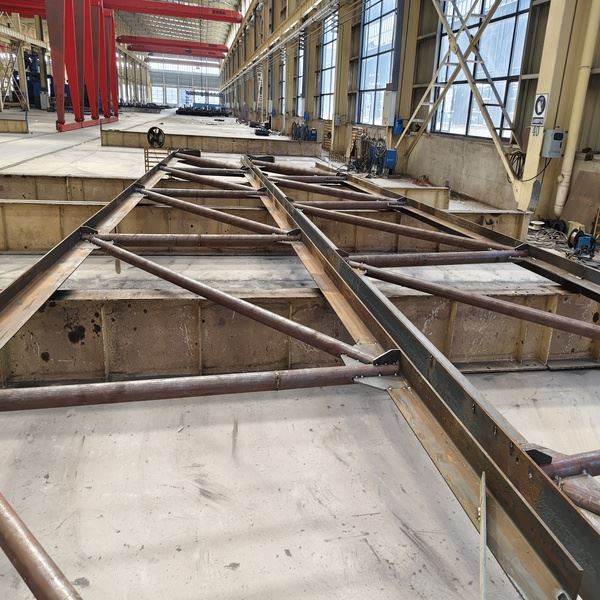
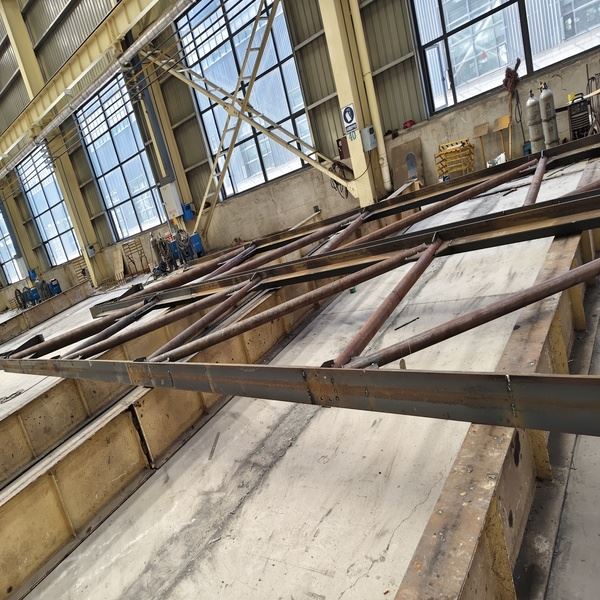
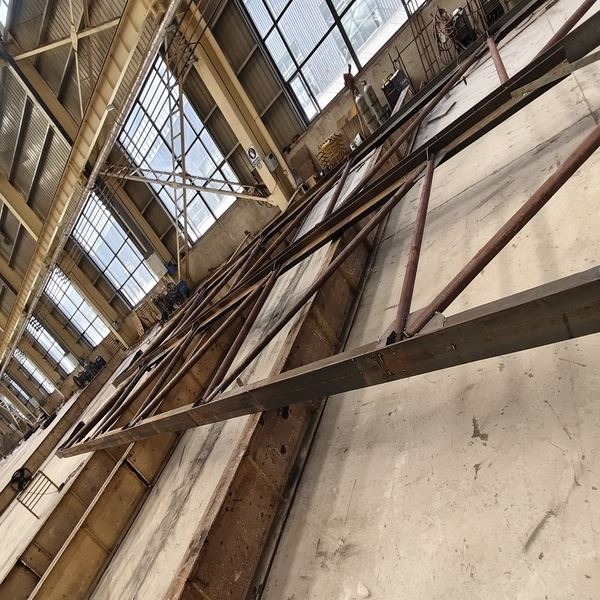
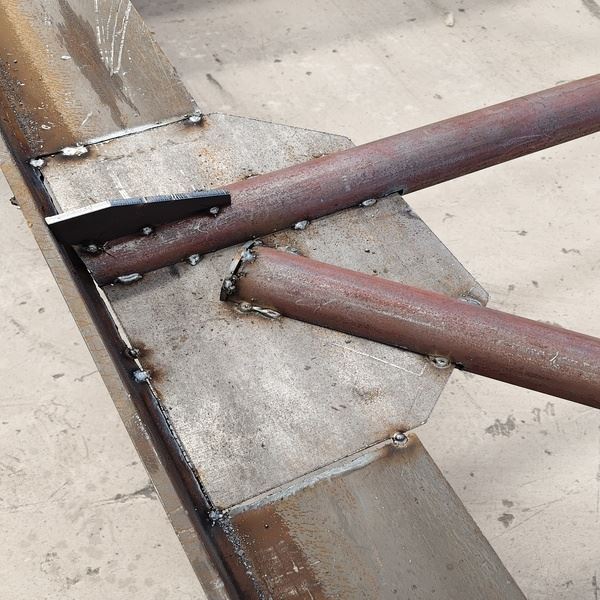
A steel lattice column is a vertical load-bearing structural member composed of main chords connected by batten plates or lacing bars in a triangulated or grid pattern. Its open-web design concentrates steel at the perimeter where stress is highest, delivering a superior strength-to-weight ratio - typically saving 15%–25% steel versus solid-web columns. We provide factory-direct lattice column fabrication to your Tekla or CAD drawings, certified to AWS D1.1 / EN 1090 / AISC standards.

Types of Steel Lattice Columns - Batten-Plate vs Laced
Based on different bracing configurations, lattice columns fall into two main categories: batten-plate type and laced type. Both share the same engineering principle - expanding the distance between chords to increase the Moment of Inertia and reduce the Slenderness Ratio - but differ in construction and optimal use cases.

Batten-plate Lattice Column
Structure: Main chords connected by horizontal steel batten plates perpendicular to the column axis.
Key Advantage: Provides clean, rigid frame behavior. Easier to fabricate and inspect, making it a cost-effective solution for medium-height columns with lower lateral load requirements.
Best For: Workshop interior columns, pipe racks, and equipment supports.
Laced Lattice Column
Structure: Triangulated truss system using angle steel or pipes as diagonal lacing bars.
Key Advantage: Offers superior overall stiffness and torsional resistance. Designed to handle significant slenderness ratios and heavy vertical loads without compromising structural integrity.
Best For: Heavy-duty industrial cranes, high-voltage transmission towers, and large-span infrastructure.

Regardless of the configuration your project demands-whether Battened or Laced-our commitment to structural integrity and engineering precision remains the same.For every lattice column we fabricate, our standard delivery package includes: certified shop drawings (3D detailing for approval before production), full material traceability (MTC 3.1), stringent weld inspection (100% Visual + UT/MT reports), and trial assembly of critical sections.
Lattice Columns Specification
| Description | Structural Steel Lattice Columns |
| Material | Q235B, Q355B/D/E, S235JR, S355JR/J0/J2, ASTM A36, A572 Grade 50 |
| Standard | ASTM, AISC, EN 1090-2, AS/NZS 1554, GB/T 1591 |
| Metal Processing | CNC Cutting, Automated Submerged Arc Welding (SAW), CO2 Shielded Welding, Drilling, Sandblasting |
| Certification | ISO 9001:2015, CE (EN 1090), AWS Welder Qualification, SGS/BV Factory Audit |
| Application | Industrial Workshops, Warehouses, Transmission Towers, Mining Infrastructures, Bridge Supports |
| Machining precision | According to ISO 13920 class B or specified project requirements (typically ±2mm) |
| Surface treatment | Hot-Dip Galvanized (ISO 1461), Epoxy Zinc-Rich Primer, Polyurethane Topcoat,Sa 2.5 Shot Blasting |
| Transport | Sea Freight (40'OT/FR Container) or Bulk Carrier |
| Design Support | Tekla Structures (3D Modeling), AutoCAD (Shop Drawings) |
| Packing details | Standard package/Pallet or Container/As per customized specifications |
| MOQ | Small order is accepted |
How to Choose the Right Lattice Column for Your Project?
Selecting the optimal lattice column steel structure depends on your load profile, height, and lateral force requirements. Use the guide below, or contact our engineers for a free design review.
| Application Scenario | Recommended Main Chord | Lacing Type | Key Consideration |
|---|---|---|---|
| Light factory / medium span (≤20m) | H200–H400 | Batten-plate | Cost-efficient, easier fabrication |
| Heavy-duty plant with overhead crane | H400–H600 or box section | Cross bracing + reinforced nodes (laced) | Fatigue from crane dynamic loads |
| High-rise / support tower | Box column or round tube (Φ219–Φ406) | H-section X-web (laced) | Wind & seismic resistance |
| Transmission tower (50m+) | Round tube, triangular layout | Symmetrical inclined struts (laced) | Slenderness ratio control |
| Bridge pier / pylon | Custom box or tube | Triangulated lacing (laced) | Torsional + seismic capacity |
| Pipe rack / equipment support | H200–H400 or angle | Batten-plate | Utility routing through hollow core |


Features & Advantages of Steel Lattice Columns
Superior Structural Stability
By expanding the distance between chords, lattice columns significantly increase the Moment of Inertia and Radius of Gyration, effectively lowering the Slenderness Ratio and providing much higher resistance to axial buckling compared to solid-web columns.
01
Significant Material & Cost Efficiency
The hollow configuration concentrates steel at the perimeter where stress is highest, eliminating the "dead weight" of a central web. This typically results in 15%–25% steel savings in large-scale industrial frames, directly reducing overall project costs.
02
Optimized Logistics & Faster Installation
Due to their lightweight yet rigid nature, lattice steel columns require smaller capacity cranes, reducing onsite lifting costs by approximately 20%. Their modular design and high factory pre-fabrication precision ensure seamless onsite assembly with minimal rework.
03
Versatile Engineering Adaptability
Lattice columns can be precisely engineered into various geometries (two-leg, four-leg, or star-shape) to withstand specific wind or seismic loads. They are the ideal solution for extra-tall structures (50m+) and large-span infrastructures where solid sections are not feasible.
04
Functional Integration Capability
The internal void within the lattice framework allows for integrated routing of industrial utilities such as pipes, electrical cables, and drainage systems, optimizing architectural space.
05
Lattice Column vs Solid-Web Column - Why Choose Lattice?
| Metric | Steel Lattice Column | Solid H-Section Column |
|---|---|---|
| Steel usage | 15–25% less | Baseline |
| Self-weight | Significantly lower | Heavier |
| Slenderness ratio | Lower (larger gyration radius) | Higher |
| Max practical height | 50m+ feasible | Economically limited |
| Foundation load | Reduced | Higher |
| Internal utility routing | Yes (hollow core) | No |
| Crane capacity needed | ~20% smaller | Larger crane |
For tall, slender, or large-span structures where weight and wind resistance matter, lattice steel columns are the engineered choice over solid sections.

Applications of Lattice Columns
1.Building Support: Applied as frame columns and standalone columns in construction frameworks to deliver high load-bearing capacity and structural stability.
2.Bridge Construction: Used for bridge piers and pylons, offering outstanding load capacity and seismic resistance.
3.Tower Structures: Ideal for high-rise telecommunication and power transmission towers with reliable wind resistance and overall stability.
4.Industrial Equipment Support: Serves as supporting frames for cranes, conveyors, and other industrial machinery, featuring superior load capacity and long-term durability.
5. Pipe Rack Supports
The hollow core of lattice columns enables integrated pipe and cable routing - ideal for chemical plants, refineries, and utility corridors where space optimization is critical.
6. Mining & Port Infrastructure
Used in mine shaft supports, port crane structures, and bulk material handling systems where heavy dynamic loads and corrosive environments demand both strength and durability.

Our Lattice Column Fabrication Services
Crafting a steel lattice column demands precision at every stage - its complex geometry of chords, battens, and lacings requires advanced equipment and highly trained welders. Our 7-step fabrication process ensures structural integrity from design to delivery.
1. Professional Shop Detailing
Converting architectural designs into precise fabrication models and shop drawings using Tekla Structures (3D) and AutoCAD, ensuring 100% structural accuracy before production.
2. High-Precision CNC Cutting
CNC plasma and laser cutting of heavy steel plates and complex sections, including beveling for high-strength weld preparations.
3. Advanced Structural Welding
Certified welding for chords and lacings under AWS D1.1 / EN standards using automated submerged arc welding (SAW) and CO2 shielded welding, ensuring maximum penetration and load-bearing integrity.
4. CNC 3D Drilling & Punching
Automated drilling for high-strength bolt connections to guarantee perfect hole alignment during onsite assembly.
5. Mechanical Straightening & Correction
Correcting post-welding thermal deformation to ensure strict verticality and straightness of long lattice columns, followed by thermal stress relief where required.
6. Industrial Surface Treatment
Achieving Sa 2.5 cleanliness via shot blasting, followed by high-performance anti-corrosion coating or hot-dip galvanizing per ISO 1461.
7. Shop Trial Assembly
Mandatory pre-assembly of critical column segments to eliminate onsite installation risks and ensure seamless fit-up.


Quality Assurance & Inspection Standards
Every structural steel lattice column we fabricate undergoes a multi-stage inspection protocol aligned with international standards. Full traceability from mill to site is guaranteed.
| Inspection Point | Key Standard | Testing Method |
|---|---|---|
| Material composition | Q355B / ASTM A572 Gr.50 | Spectroscopic analysis + MTC 3.1 |
| Weld integrity | AWS D1.1 / EN 1090-2 | 100% Visual + Ultrasonic (UT) / Magnetic Particle (MT) |
| Dimensional accuracy | ISO 13920 Class B (±2mm) | CMM / tape + plumb line |
| Load-bearing capacity | 1.5× design load | Hydraulic load testing (up to 500t) |
| Surface preparation | Sa 2.5 | Profile gauge + cleanliness test |
| Galvanizing thickness | ISO 1461 | Magnetic thickness gauge |
All shipments include: MTC 3.1 Mill Test Certificates, welder qualification records (AWS), UT/MT inspection reports, and dimensional check sheets.
Who Uses Our Steel Lattice Columns?
As a direct lattice column manufacturer and supplier, we serve clients across the global construction and infrastructure supply chain:
Engineering contractors & steel subcontractors - turnkey fabrication per project drawings, with full MTC traceability.
Industrial plant investors - cost-optimized steel solutions with 15–25% material savings.
Design institutes - collaborative 3D modeling (Tekla) and structural optimization support.
Government project owners - CE/EN 1090 & AWS certified compliance for public infrastructure.
Trading companies & distributors - flexible MOQ, OEM packaging, and competitive factory pricing.
Bridge & infrastructure developers - large-span and heavy-load fabrication expertise.

Packing, Delivery & Logistics of Lattice Columns
For projects involving steel frame column installations, logistics matter. Lattice columns excel here: their open-web design reduces weight by 25–35% compared to solid columns, making them easier to transport and handle on-site. Modular sections can be pre-assembled off-site and bolted together quickly, and their slender profile fits standard 40' containers more efficiently, reducing shipping costs by 15–20% versus bulkier solid sections.
1. Steel Frame Bundling
Columns are secured on customized steel cradles to prevent structural bending and deformation during transit.
2. Node & Flange Protection
All connection flanges and bolt holes are shielded with plywood or rubber caps to prevent rust and impact damage.
3. Paint Finish Preservation
Edges are wrapped with EPE foam or anti-friction padding to avoid scratches and maintain coating integrity.
Transport options: Sea freight (40' OT/FR container) or bulk carrier. Packing per customized specifications.
Production Lead Time & Delivery Schedule
Standard production lead time for steel lattice columns is 25–45 days, depending on project scale, complexity, and quantity. Below is the typical production timeline breakdown:
| Stage | Standard Project | Large-Scale / Complex |
|---|---|---|
| 1. Shop Detailing & Design (Tekla/CAD) | 3–5 days | 7–10 days |
| 2. Material Procurement (steel plates, sections) | 5–7 days | 10–14 days |
| 3. CNC Cutting & Welding Fabrication | 8–12 days | 12–18 days |
| 4. Surface Treatment (blasting + galvanizing/coating) | 3–5 days | 5–7 days |
| 5. Trial Assembly & QC Inspection | 2–3 days | 3–5 days |
| 6. Packing & Container Loading | 1–2 days | 2–3 days |
| Total Production Lead Time | 25–30 days | 35–45 days |
| Sea Freight (to main destination ports) | 15–30 days (varies by route) | |
Need a faster turnaround? Rush production (15–20 days) is available for urgent projects with ready-approved drawings. Contact us with your project details for a precise delivery schedule.

FAQ:
What is a steel lattice column and when should I use one?
A steel lattice column is a vertical load-bearing member with an open-web design of chords and lacing bars. Use it for tall structures (50m+), large-span buildings, heavy crane supports, and transmission towers where a high strength-to-weight ratio and wind resistance are critical. It typically saves 15–25% steel versus solid H-section columns.
Batten-plate vs laced lattice column - which type do I need?
Choose batten-plate type for medium-height columns, pipe racks, and equipment supports - it's easier to fabricate and more cost-effective. Choose laced type for heavy-duty cranes, transmission towers, and large-span structures requiring superior torsional resistance and high slenderness ratio capacity.
Can you fabricate lattice columns to my drawings?
Yes. We provide full custom lattice column fabrication based on your Tekla Structures or AutoCAD shop drawings. We also offer 3D modeling and structural optimization support. Certified shop drawings are submitted for your approval before production.
What steel grades and standards do you comply with?
We fabricate in Q235B/Q355B, S235JR/S355JR, ASTM A36/A572 Gr.50. Compliance standards include ASTM, AISC, EN 1090-2 (CE), AS/NZS 1554, and GB/T 1591. Each shipment includes MTC 3.1 mill test certificates.
How do you ensure welding quality?
All welding is performed by AWS D1.1 / EN qualified welders using automated submerged arc welding (SAW) and CO2 shielded welding. 100% visual inspection plus ultrasonic testing (UT) and magnetic particle testing (MT) reports are provided per international standards.
What surface treatment options are available for corrosive environments?
For outdoor, coastal, or industrial environments, we offer hot-dip galvanizing (ISO 1461), epoxy zinc-rich primer + polyurethane topcoat systems, or a combination. All surfaces are prepared to Sa 2.5 via shot blasting. Custom coating systems are available for marine and mining applications.
Can your lattice steel columns meet wind and seismic requirements?
Yes. We engineer lattice steel columns to withstand project-specific wind and seismic loads per local design codes. The triangulated bracing design inherently provides excellent lateral resistance and torsional stiffness for high-rise and tower structures.


