


Purlins & Girts
What Are Steel Purlins & Girts?
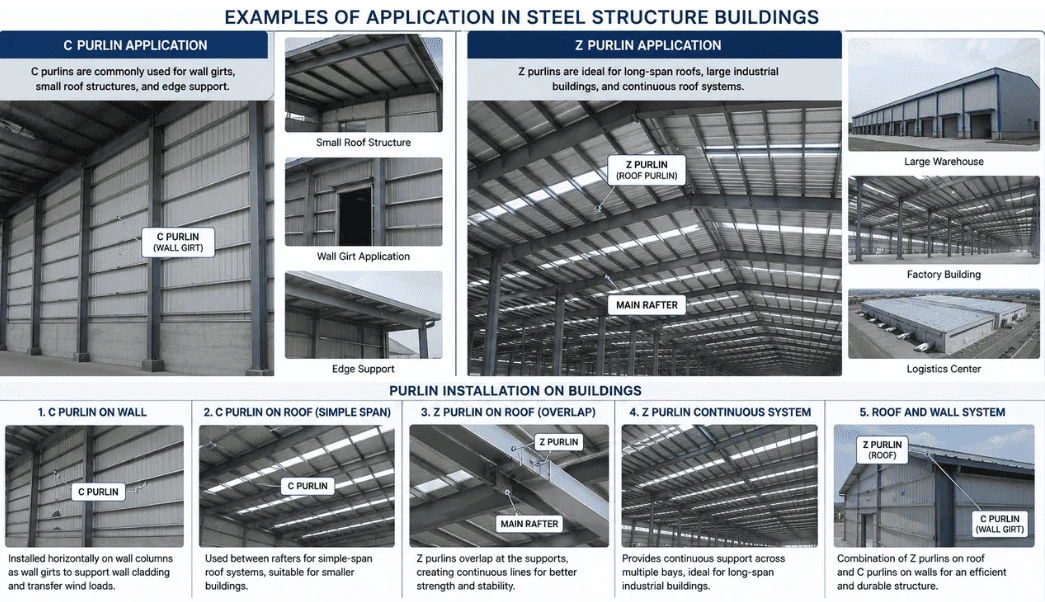
Purlins and girts are the secondary structural members of steel-frame buildings. Purlins run on the roof to support roof panels and transfer roof loads to the main frame, while girts run horizontally in the walls to support wall panels and resist wind loads. Together they tie the building envelope to the primary steel frame.
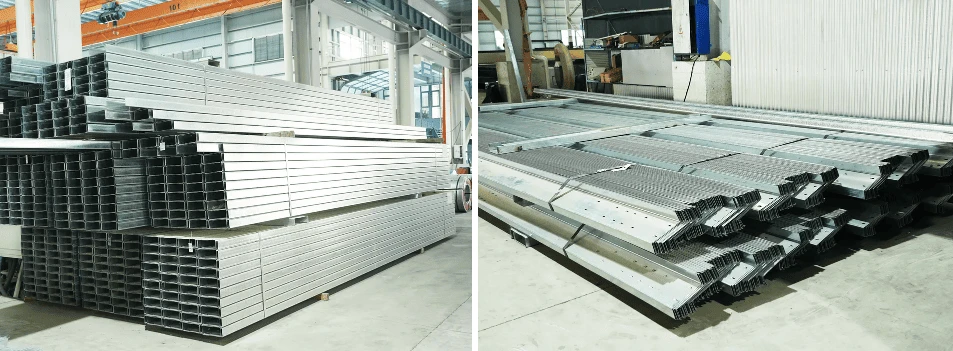
Both are usually roll-formed into C-section or Z-section from galvanized cold-formed steel — lightweight, dimensionally precise, corrosion-resistant, and quick to install. Widely used in pre-engineered buildings, industrial workshops, warehouses, factories and commercial structures. This page also helps you pick between C and Z, set spacing, and choose the right galvanizing.

Our Purlins & Girts Range


Purlins vs. Girts: What's the Difference?
| Factor | Purlins (Roof) | Girts (Wall) |
|---|---|---|
| Position | Roof — support roof panels | Walls — support wall panels |
| Main loads | Roof self-weight, snow & wind uplift | Lateral wind loads transferred to main frame |
| Typical section | C / Z | C / Z / heavier wall girts |
| Connection | Clipped / bolted to roof beams | Bolted to columns / wall frames |
Not sure which fits your design? Send us your drawings and our engineers do a 1:1 section check — free.
Roles of Steel Purlins & Girts
Load Transfer
Directly carry dead loads and live loads from roof or wall panels, such as wind loads and snow loads, and safely transfer them to the main rigid frame.
Stability Enhancement
Form a stable system with main beams via connectors including sag rods and bracing struts, to prevent lateral instability of the main steel frame.
Seismic Bracing
Provide spatial restraint under earthquakes or strong winds to absorb and distribute horizontal external forces.
Benefits of Steel Purlins & Girts
High Strength & Light Weight
Manufactured by cold‑formed thin‑wall technology with typical thickness ranging from 1.5 mm to 3.0 mm, mostly in C‑section or Z‑section profiles. Compared with conventional hot‑rolled steel sections, it reduces the self‑weight of roof systems by 30%‑50%.
01
Precision & High Efficiency
Standardized factory prefabrication achieves hole‑position tolerance below 1 mm. Bolt‑assembly is adopted on‑site, cutting the construction cycle by more than 40 % compared with traditional concrete structures.
02
Cost‑Effective Span Performance
The conventional economical span ranges from 4 m to 6 m. When Z‑sections are applied with continuous lap‑joint arrangement, flexural capacity is improved by approximately 30 % versus simply‑supported single‑span design.
03
Fast Site Installation
Fully prefabricated in factory and bolt‑connected on‑site with no wet‑work required. Construction efficiency is more than doubled compared with traditional concrete components, shortening the overall project schedule.
04
C vs. Z Sections — Which One to Choose?
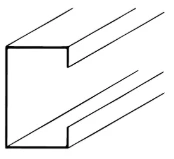
C-Section
Centre of gravity in the middle — easy end detailing, suited to smaller spans, simple roofs, wall girts and framed openings.

Z-Section
Nest & lap together for continuous spans — ideal for large industrial roofs and long roof runs. Strength improves with lap-joint continuity.
Quick rule: big roof → Z; simple short spans & wall girts → C. Still unsure → send your loading, we'll confirm.
How to Select: A Quick First-Pass
Choice is driven by span, loads and exposure. This quick reference gets you a solid starting point — we confirm the final section, spacing and coating against your drawing.
| Application | Typical span | Recommended section | Spacing (start) | Coating |
|---|---|---|---|---|
| Industrial / large roof | 9 – 12 m+ | Z-section, continuous lap | Roof-sheet dependent | Hot-dip Z200–Z275 |
| Workshop / small roof | 4 – 6 m | C-section | ≈ 1.5 m | Z120–Z180 |
| Wall girts | Column pitch | C or Z section | Wind-load dependent | Z180–Z275 |
| Heavy roof / large venue | 12 m+ | Z-section + bracing | Engineered | Z275+ or prepaint |
Quick path: ① define span & roof type → ② check loads (wind, snow, dead) → ③ pick C or Z → ④ choose coating by exposure & pre-punch to drawing. Send us these and we confirm the details with the quote.
Applications of Steel Purlins & Girts
Industrial Steel Workshops:main secondary structure for roof and wall cladding, supporting roof panels and wall sheets, improving overall building stiffness, wind resistance and seismic performance.
Steel Structure Warehouses & Logistics Parks:ideal for large-span and open-span buildings with lightweight structure and fast installation for standard industrial projects.
Aircraft Hangars & Large Venues:z-section purlins provide excellent structural continuity and bending resistance to meet large-span roof and high wind load requirements.
Agricultural Steel Buildings:widely used for farm sheds, livestock shelters and greenhouses with reliable outdoor anti-corrosion performance.
Solar PV Support Structures:c/u steel profiles serve as secondary support and reinforcement components for rooftop solar mounting systems.
PEB Pre-engineered Steel Buildings:standard secondary structural members for modular prefabricated steel construction with fast on-site assembly.
Steel Building Renovation & Reinforcement:applied in roof and wall upgrading, structural reinforcement and old project reconstruction with customized profile sizes.
Standard Section Dimensions
Common C- and Z-section series in cold-formed purlin / girt production, with theoretical weight per metre for reference. Custom depths up to 300mm are available.
| Section (h × b × c) | Type | Thickness | Weight (kg/m, ref.) | Typical span |
|---|---|---|---|---|
| C100 × 50 × 20 | C | 2.0 mm | ≈ 3.8 | 4 – 5 m |
| C120 × 50 × 20 | C | 2.0 – 2.5 mm | ≈ 4.1 – 5.1 | 4 – 6 m |
| C140 × 50 × 20 | C | 2.0 – 2.5 mm | ≈ 4.4 – 5.5 | 5 – 6 m |
| C160 × 60 × 20 | C | 2.0 – 2.5 mm | ≈ 5.0 – 6.3 | 6 – 7 m |
| C200 × 70 × 20 | C | 2.0 – 3.0 mm | ≈ 5.3 – 8.0 | 7 – 8 m |
| C250 × 80 × 20 | C | 2.5 – 3.0 mm | ≈ 8.4 – 10.1 | 8 – 9 m |
| Z200 × 70 × 20 | Z | 2.0 – 2.5 mm | ≈ 6.0 – 7.5 | 6 – 8 m |
| Z220 × 75 × 20 | Z | 2.0 – 2.5 mm | ≈ 6.4 – 8.1 | 7 – 9 m |
| Z250 × 80 × 20 | Z | 2.5 – 3.0 mm | ≈ 8.8 – 10.6 | 8 – 10 m |
| Z300 × 90 × 20 | Z | 2.5 – 3.5 mm | ≈ 10.2 – 14.3 | 10 – 12 m |
Note:weights are theoretical; we cut each piece to your drawing with CNC precision. Custom depths, thicknesses and hole patterns available on request.

Specifications at a Glance
| Parameter | Typical Range / Option |
|---|---|
| Section depth | 80 – 300 mm (custom) |
| Wall thickness | 1.0 – 3.5 mm (steel-sheet gauge dependent) |
| Steel grade | Q235 / Q345 or G350 / G450 / G550 equivalents |
| Coating | Hot-dip galvanized (Z120 – Z275+), prepainted / custom |
| Fabrication | CNC cut-to-length, pre-punching, house-stamping, bending |
| Standards | ASTM A653 / EN 10346 / AS/NZS 4600 / GB/T 6723 |
| Quality | SGS / BV third-party inspection, full MTC & certificates |
Note:Contact us for the full downloadable spec sheet & span tables matched to your drawing.
Why Choose Us?
We supply C‑section and Z‑section steel purlins together with cross bracing members. Available surface finishes include hot‑dip galvanizing and pre‑galvanizing. Custom fabrication services such as cutting‑to‑length, pre‑punching and pre‑bending are offered upon client requirements. All products comply with GB, ASTM, EN, AS/NZS and other relevant standards.
International Standard Production & Complete Qualifications
We produce to ASTM / EN / AS-NZS / GB and supply full MTC material certificates & galvanizing certificates. Third-party SGS / BV inspection is supported for customs clearance.
High-precision Manufacturing & Easy Installation
Fully-automatic cold-forming lines with CNC cut-to-length & pre-punching hold hole-tolerance under 1mm, matching drawings 1-to-1 — install on arrival, no rework.
Full-range Customization Service
Non-standard sections, wall thickness, irregular hole patterns and lap-joint structures are made per project, with fast sampling then mass production.
Professional Full-cycle Support
One-on-one technical & export team: drawing review, production follow-up, container-loading check, installation guidance — with prompt after-sales support.


Surface Treatment Services
Your exposure decides the right finish — and we handle the full range in-house: hot-dip galvanizing (Z120–Z275+), prepainted, plus custom zinc grades on request.
| Finish option | Aimed at | Outcome |
|---|---|---|
| Pre-galvanized / Z120–Z180 | Interior, dry | Cost-efficient standard protection |
| Hot-dip galvanized Z200–Z275 | General exterior | Longer life, lower maintenance |
| High zinc-layer Z275+ / prepainted | Coastal, humid, industrial | Maximum corrosion resistance |
Not sure which finish? Tell us your site and environment — we recommend the right zinc layer and supply the galvanizing certificate.
Our Production Process

1.Uncoiling & leveling
Galvanized or prepainted steel coil is uncoiled and leveled to guarantee a flat, consistent strip before forming.
2.Cold roll-forming to section
The strip is roll-formed into the C or Z profile to your drawing, across 10+ automated forming lines.
3.CNC cut-to-length & pre-punching
CNC precision cutting and pre-punching set every hole — slot, rivet and bolt holes — to the drawing with under 1mm tolerance.
4.Straightening & inspection
Each member is straightened and dimensionally checked against the drawing before it moves on.
5.Surface finishing / galvanizing
Coating is applied by exposure — hot-dip galvanizing (Z120–Z275+) or prepaint — and verified with the coating certificate.
6.Packing & QC sign-off
Final QC, material certificates and secure packing; every batch is traceable and ready for shipment.
Every step runs on fully-automatic cold-forming lines with CNC precision — hole tolerance under 1mm, parts matching drawings 1:1.
Quality Control for Purlins & Girts
| Check point | Control standard | Inspection method |
|---|---|---|
| Raw material | Steel grade & coil per order (Q235/Q345 or G350–G550) | MTC material certificate, batch traceability |
| Section dimension (h, b, lip) | Within drawing tolerance — GB/T 6723 / ASTM / EN | Caliper & template check on each run |
| Wall thickness | 1.0 – 3.5 mm per order | Micrometer sampling |
| Cut length | Per drawing, length tolerance held | CNC cutting + measuring-tape check |
| Hole position (slot, rivet, bolt) | < 1 mm from drawing | CNC pre-punch + template verification |
| Straightness & twist | Within standard limit | Straight-edge check |
| Galvanizing / coating | Z120 – Z275+ to order | Coating-thickness gauge + certificate |
| Final QC & documents | Batch sign-off | Document review; SGS/BV third-party on request |

Length and Bundle Check

Section Size Check

Wall Thickness Check
Packaging, Transportation & Lead Time
| Stage | What we do | Typical lead time |
|---|---|---|
| Production | Standard C/Z sections from stocked coil on automated forming lines | 7 – 15 days |
| Custom production | Non-standard sections, pre-punched to drawing, specified coating | 15 – 25 days |
| Packaging | Steel-banded bundles on wooden pallets or crates, edge protection for sea freight | Included with production |
| Export documentation | Packing list, commercial invoice, MTC & inspection certificates, container-loading check | Ready at shipment |
| Shipping & delivery | Sea / air / rail as required; transit depends on the destination port | ≈ 20 – 40 days by sea |
Note:times are references — we confirm exact dates with your quote. MOQ and bulk volumes are negotiable.

FAQ:
What is the difference between cold-formed and hot-rolled purlins?
Cold-formed purlins are roll-formed from thin galvanized sheet — lighter, more corrosion-resistant and quicker to install, making them the economical choice for secondary members. Hot-rolled sections are heavier and used mainly in primary framing.
How are purlins and girts installed and connected to the structure?
They are bolted or clipped to the main frame — purlins to the roof beams, girts to the columns. Across long spans, sag rods tie the purlins and wind-bracing ties the girts to the frame. We provide an installation guide with every delivery.
How long do galvanized purlins and girts last?
Service life depends on the zinc layer and the environment: a Z275+ coating serves for decades in most climates. We supply the coating certificate so you can verify the specification against your needs.
What span and load can your purlins carry?
Capacity depends on the section, spacing and applied loads. We provide verified span/load data matched to your drawing and your local wind and snow values — confirmed with the quote.
Do you provide DWG/BIM drawings and a formal quotation?
Yes. We review your drawing free of charge, supply DWG/BIM files on request, and give an itemized quotation covering specification, packaging and shipping.
Can I order a small trial quantity before a bulk order?
Absolutely — trial orders are welcome so you can approve quality and installation first. We then scale to mass production with a stable lead time.
Do you export worldwide and which Incoterms do you support?
We export to most global markets and support FOB, CIF and CFR, with DDP available on request. Every container is checked before loading.
Are your purlins suitable for coastal, seismic or high-wind regions?
Yes. For coastal sites we recommend a higher zinc layer, and for wind/seismic zones we design additional bracing and lap continuity — tell us your location and we adapt the supply.
As one of the most professional purlins & girts manufacturers and suppliers in China, we have world-leading production equipment and strong manufacturing capabilities. Please rest assured to buy customized purlins & girts at competitive price from our factory. For quotation, contact us now.
High Strength Wall Girts, purlins girts, Z Type Purlin