

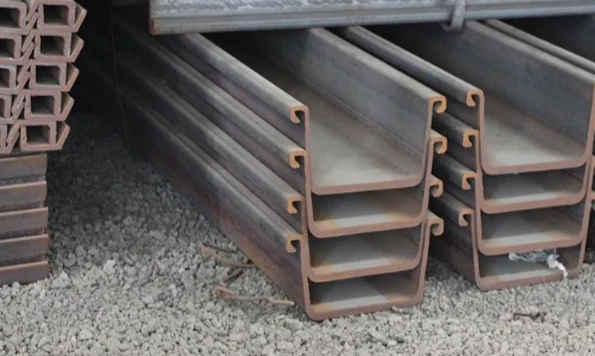
U-shaped steel sheet piles are hot-rolled steel profiles with a symmetrical U-shaped cross-section that join through interlocking edges into a continuous wall that retains soil, resists water flow, and cuts off seepage. For river bank revetment they stand out by stabilising and protecting the shoreline with a vertical structure, keeping riparian land use intact without narrowing the channel, offering a watertight interlock, and allowing long, fast linear construction - whether as a permanent flood-defence and protection wall or as a temporary structure to manage water during construction.
What Are U-Shaped Steel Sheet Piles?
A U-shaped steel sheet pile is a hot-rolled steel profile with a symmetrical U-shaped cross-section. Each pile carries a dedicated interlock along both vertical edges; when adjacent piles are interlocked and driven, they close into a continuous wall that retains soil, resists flow, and cuts off groundwater and seepage.
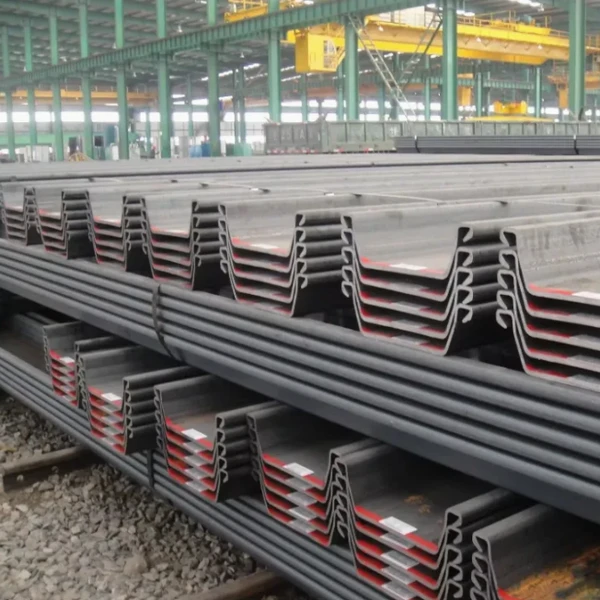
U-piles are produced in Type 2/3/4 and corresponding series, in sizes such as 400×100×10.5 mm, with a watertight interlock relied on for revetment service. They are manufactured to EN 10248, ASTM, and JIS A 5528 across steel grades from S275 and S355 to SY295, SY390, S355GP, and ASTM grades, in lengths made up to suit the bank height, and are installed with vibratory, impact, or press-in hammers.
Why U-Shaped Steel Sheet Piles Are Used for River Bank Revetment?
River bank revetment must stop erosion, keep flood water within the channel, and do so along long, linear stretches of bank. The profile of the U-shaped pile matches these demands closely.
Erosion and scour resistance. A driven steel wall cuts through erodible bank material and takes the full force of flow and waves, protecting the toe and crest from scour rather than simply armouring the surface.
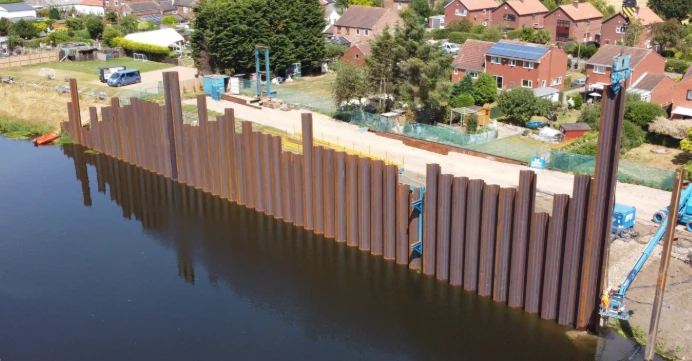
Saves riparian land and keeps flow capacity. Because the wall is vertical, it does not encroach on the channel; the river's cross-section and conveyance stay intact, which matters where land is scarce or flow must be preserved.
Watertight interlock. The well-proven Larssen interlock seals the joints, holding back seepage behind the bank and keeping the protected side stable through varying river levels.
Fast linear construction. Piles are driven directly into the ground with no curing or formwork, so long bank lengths are completed far faster than cast or masonry revetment.
Temporary or permanent service. The same standard product can act as permanent flood protection or be recovered after temporary works, giving flexibility to construction staging.
Typical Applications in River Engineering
U-shaped steel sheet piles support the management and protection of river banks across a range of works:
River training and bank protection - stabilising eroding banks and holding the designed channel alignment.
Flood defence - forming or strengthening longitudinal levees and flood walls that keep rising water within the channel.
Scour protection - protecting toe, piers, and structures from localised bed scour where flow is accelerated.
Composite revetment - paired with slope protection such as rip-rap, concrete, or an energy-dissipating apron behind or in front of the wall.
Intake and diversion structures - guiding flow and protecting the banks of water-intake and diversion works.
Structural Forms of Sheet-Pile Revetment
The wall is arranged according to bank height, soil, and flow conditions:
Freestanding and anchored walls. For low or shallow banks the piles act as cantilevers; for higher banks or soft ground, ground anchors or tie-backs add a support point so economical sections are used.
Toe and crest treatment. An apron, rip-rap, or scour cushion placed at the toe anchors the wall and controls local scour; a capping or ballast beam ties the top of the piles together.
Composite sections. The pile wall can be combined with a concrete capping beam and slope paving to form a robust permanent revetment cross-section.

Design Considerations for River Bank Revetment
Scour depth is the central design driver for a sheet-pile revetment, because it sets the required penetration and the load the wall must resist.
Flow velocity and scour depth. Design scour depth governs how far the piles must be driven below the bed to remain secure and to protect the toe.
Bed and bank conditions. Soil stiffness, groundwater, and erodibility of the bank material determine achievable penetration and the support the wall receives.
Flood and wave action. The section must resist the highest design water level and the hydraulic force of flow and wave impact without excessive deflection.
Corrosion and abrasion. In fresh water, corrosion rates are commonly low, while sediment-laden flow can abrade exposed faces; an allowance can be added to the exposed face before the section is fixed.
Steel Grades and Standards Across Regions
Because river projects are specified across markets, the grade is usually stated to a regional standard. The sheet-pile standards differ in units and in how grade is named, yet comparable engineering outcomes can be achieved across them.
| Standard | Units | Representative Grades | Naming Logic |
|---|---|---|---|
| EN 10248 | Metric / MPa | S240GP, S270GP, S355GP, S430GP | Yield strength (MPa) + GP |
| ASTM A328 / A572 / A690 | Imperial / ksi | A328, A572 Gr. 50, A690 | Specification + strength grade |
| JIS A 5528 | Metric / MPa | SY295, SY390 | Yield strength (MPa) + Y |
| Regional codes (e.g. DB42/T 1035) | Metric | Model and performance classes of U-piles | Type / performance / use |
In practice, an Asian river bank project is often specified to EN 10248, while a marine-adjacent specification may reference ASTM A690 for corrosion resistance. The section and grade are then confirmed against the mill certificate to the agreed standard.
Construction of Sheet-Pile Revetment
Revetment piling is driven along the bank, then combined with toe treatment and backfill:
Piles are pitched and guided by a frame so the wall stays aligned and plumb along the bank alignment.
Vibratory hammers drive U-piles efficiently in soil and soft ground; impact hammers add force in stiff strata or gravel, while press-in rigs provide a low-noise option near built-up riparian areas.
Larssen interlocks are cleaned and lubricated before driving so joints slide freely and the watertight seal holds.
Toe scour protection - rip-rap, an apron, or a scour cushion - is placed and graded, then backfill or slope paving completes the section.
Where piling is temporary, extraction recovers clean piling for reuse and the bank is finished to the permanent design.

Conclusion
U-shaped steel sheet piles give river bank engineering a stable, watertight line of defence that stops erosion, keeps flood water within the channel, protects the toe from scour, and secures long stretches of bank far faster than cast or masonry revetment. Driven as freestanding or anchored walls and finished with toe protection and capping, they deliver the shear resistance, the watertight face, and the linear speed that river works require, under EN 10248, ASTM or JIS as the site demands. For a project along a living river, that is a practical and economical way to keep the bank in place and protect what lies behind it.
Planning a river bank or flood-defence project? Send your bank length and height, soil and groundwater conditions, design flow and scour depth, and required standard, and our engineers will recommend the right U-shaped grade and section.
Contact now to get U-shaped steel sheet piles
FAQ:
How long do steel sheet piles last in a fresh-water river?
In fresh water the corrosion rate is generally low and well below tidal or marine exposures, so unprotected heaps typically serve many decades. Service life is set against the design depth of the section and can be extended further where needed by adding a corrosion allowance or, in aggressive service, a protective coating.
Will the sheet pile be undermined by river scour?
No, provided the design penetration is set from the design scour depth and the toe is protected. Driving the wall below the anticipated scour and adding a toe apron or rip-rap keeps the wall anchored and the toe stable under accelerated local flow.
Can a sheet-pile wall withstand flood water and fast flow?
Yes, when the section, penetration, and support arrangement are designed for the highest design water level and flow/wave force. A stiff, well-supported wall resists hydraulic force with limited deflection and keeps the protected side stable across varying river levels.
Is the revetment temporary or permanent?
Either. The same standard U-pile can remain as permanent flood-defence and bank protection or, in temporary works, be extracted and reused after the permanent structure is in place. The choice depends on whether the wall is part of the permanent cross-section.
What information is needed for a quotation?
Share the bank length and height, soil and groundwater conditions, design flow and scour depth, desired standard (EN 10248, ASTM, or JIS), pile length and quantity, and any permanent-wall or coating requirement. With these, an engineer can recommend the grade, section, and driving scheme for the site.