

U-shaped steel sheet piles are hot-rolled sections whose interlocked edges close into a continuous, earth- and watertight wall. For a quay wall they bring high bending strength for deep berths, a watertight Larssen interlock, long marine life, and clean end-of-life recovery. This article explains where and why they are used - the anchored, cantilever, and combi systems, the container and mooring facilities, the parameters that govern section and grade choice, and the corrosion protection and waterborne installation that keep the wall in service for decades.
What Are U-Shaped Steel Sheet Piles?
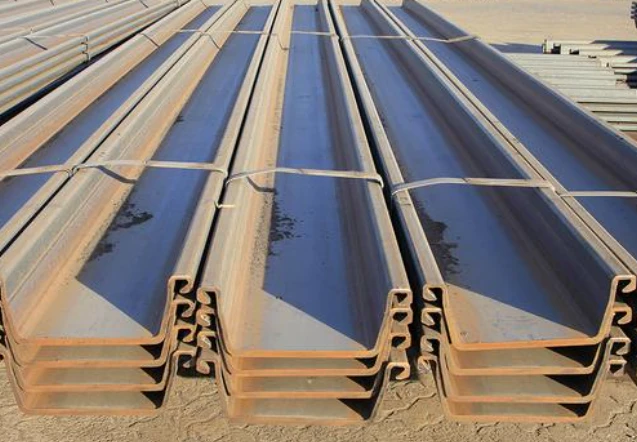
A U-shaped steel sheet pile is a hot-rolled steel profile with a symmetrical U-shaped cross-section. Each pile carries a dedicated interlock along both vertical edges; when adjacent piles are interlocked and driven, they close into a continuous, earth- and watertight wall. Because the profile is symmetrical, pairs can also be pitched to act like a box section, and the geometry is well suited to forming curved or circular walls. U-piles are produced in the PU, AU, and GU series under EN 10248, JIS A 5528, and ASTM standards, in single-pile widths from about 400 to 750 mm and wall depths from about 200 to 500 mm, and are installed with vibratory or impact hammers.

Roles of U-Shaped Steel Sheet Piles for Quay Wall Engineering
A quay wall does more than hold back soil. It is the working edge of a port: the vertical face where vessels moor, where cranes and cargo move across the berth, and where the land ends and the water begins. It must carry the weight of shore cranes and stacked cargo behind it, absorb the repeated impact and pull of ships alongside, and separate retained ground from the harbour basin for the life of the terminal. The U-shaped steel sheet pile meets this brief as a hot-rolled section whose interlocked edges close into a continuous, earth- and watertight face.
A quay wall differs fundamentally from an ordinary retaining wall or a temporary cofferdam in two respects.
First, it is subject to sustained operational loads over the long term - berthing forces, mooring pull, and surcharge from quay cranes and storage yards - rather than merely passive earth pressure and water pressure.
Second, it must serve vessels for decades, rather than being dismantled after a single construction phase.
For these reasons, the basis for selecting U-type sheet piles in such works lies in their reliable bending strength and in the tight Larssen interlocks that keep backfill and groundwater separated from the working face year after year.

Advantages of U-Shaped Steel Sheet Piles in Quay Wall Engineering
Bending Strength to Support Deep-Water Berths and Heavy Quay Cranes
Deep-water berths impose large bending moments on the wall from earth and water pressure, while the storage-yard side also carries surcharge from quay cranes and stockpiled cargo. The U-shaped section's elastic section modulus ranges from roughly 500 to 2,000 cm³/m, and its moment of inertia is about 3 to 5 times that of ordinary concrete piles - holding the deep-water face straight with controlled deflection.
Watertight Wall Face to Protect Terminal Foundations
Proven Larssen interlocks prevent backfill and tidal groundwater from leaking through and eroding the working face. In soft soils, sand strata, or highly permeable subaqueous deposits - especially in dense ports where any settlement near the berth is unacceptable - an interlocked wall is far more reliable than a concrete-pile system.
Durability to Withstand Repeated Berthing
The quay wall is continuously struck and pulled by vessels throughout its service life. Steel tolerates repeated berthing impact and the alternating action of tides and temperature far better than brittle concrete.
Efficient Footprint Where Land Is Scarce
Unlike gravity walls that require a wider base, a vertical sheet-pile wall occupies virtually no land behind it, allowing the terminal to run cranes, rails, and storage yards right up to the cap beam - preserving the premium value of scarce frontage land in crowded ports.
Reusable and Recyclable at End of Service Life
As a standard hot-rolled section, surplus or replaced sheet piles can be reused on other projects, and piles at end of life are 100% recyclable - an advantage that becomes especially pronounced at the scale of large port works.
Structural Systems for U-Shaped Steel Sheet Pile Quay Walls
Hydraulic depth and soil determine how the U-piles are tied back and how heavy the section must be.
Cantilever walls
For shallow berths and low retained heights, U-piles act as freestanding cantilevers, embedded deep enough to resist overturning. This is the simplest, most economical form for small terminals.
Anchored walls
The standard system for most conventional berths. The head of the U-pile wall is tied back to an anchor system - an anchor beam, anchor piles, or a buried anchor wall - through steel rods or strands. The anchor adds a resisting point behind the top of the wall, allowing deeper berths at reasonable cost. An access corridor built on top houses the anchors and keeps the quay surface uncluttered.
Combi walls
For very deep, exposed berths, large primary bearing piles frame the wall while U-shaped intermediate piles close the bays between them. This combi wall delivers the very high section modulus the depth demands while keeping steel weight - and cost - below that of an all-U wall sized for the same moment.
Whichever system is used, the U-piles connect at a top coping beam, which distributes berthing loads along the wall and carries the fenders and cast-in bollards that ships tie to.
Applications of U-Shaped Steel Sheet Piles in Quay Walls
U-shaped steel sheet piles support the waterfront facilities of a working port:

Container and bulk terminals - quay walls that carry heavy crane rails and deep berths behind a face built for constant vessel traffic.
Inland and barge quays - cost-effective retaining faces along rivers and canals for lighter, frequent traffic.
Mooring dolphins and pier-protection cells - isolated berthing structures and circular cells that keep ship impact off bridge piers and exposed installations.
Graving docks and cut-off walls - dry-dock enclosures and impermeable barriers around repair or contaminated-water zones.
Upgrade and repair of existing quays - driving a new U-pile wall in front of or behind an aging structure to deepen, strengthen, or relieve it without stopping terminal operations.
Design Considerations for U-Shaped Steel Sheet Pile Quay Walls
Quay wall design starts from the vessel, then works down to the section:
Berth and hydraulic parameters - design water level, wave exposure, and the charted depth the ship class needs alongside.
Berthing and mooring loads - vessel impact against the fendering and pull on the bollards, then transferred through the coping into the piling.
Ground and anchor conditions - soil strength and strata set the embedment and the anchor geometry; groundwater state matters for a watertight design.
Corrosion zoning and design life - unlike a land structure, a quay wall is protected by exposure zone: the atmospheric zone above splash, the aggressive splash zone, the tidal zone, and the quiet submerged zone. Each takes a different corrosion allowance, coating, or cathodic protection to meet the target service life.
Key takeaway: The ship classes a berth must serve set the water depth; water depth and crane loads set the section; and the target life sets the grade and corrosion treatment.

Steel Grades, Standards and Section Selection for U-Shaped Steel Sheet Piles
For marine quay work, grade is chosen for strength and corrosion behaviour and section for bending resistance. PU, AU, and GU series are produced to the principal international hot-rolling standards.
| Parameter | Typical Values / Options |
|---|---|
| Section series | PU / AU / GU (e.g., PU12, PU18, AU14, AU20, GU22N) |
| Steel grades | S270GP, S355GP, S390GP (EN 10248); ASTM A572, A690 (marine) |
| Production standards | EN 10248 (hot-rolled), JIS A 5528, ASTM A328/A690 |
| Single-pile width | 400 – 750 mm |
| Wall depth (web height) | 200 – 500 mm |
| Thickness | 8 – 24 mm |
| Section modulus (Z) | roughly 874 – 3,820 cm³/m |
| Interlock type | Hot-rolled Larssen or equivalent |
| Standard lengths | 6, 9, 12, 15, 18, 24 m; longer via welding |
In a quay wall the corrosion allowance is usually added to the exposed steel in the splash and tidal zones before the structural thickness is fixed. Reference dimensions and section properties for common PU, AU, and GU sections follow; final values are confirmed against the mill certificate for the chosen grade.
| Series | Section | Width B (mm) | Wall Depth H (mm) | Mass (kg/m) | Section Modulus (cm³/m) |
|---|---|---|---|---|---|
| AU | AU14 | 750 | 408 | 77.9 | 1 405 |
| AU16 | 750 | 411 | 86.3 | 1 600 | |
| AU18 | 750 | 441 | 88.5 | 1 780 | |
| AU20 | 750 | 444 | 96.9 | 2 000 | |
| AU23 | 750 | 447 | 102.1 | 2 270 | |
| AU25 | 750 | 450 | 110.4 | 2 500 | |
| PU | PU12 | 600 | 360 | 66.1 | 1 200 |
| PU18 | 600 | 430 | 76.9 | 1 800 | |
| PU22 | 600 | 450 | 86.1 | 2 200 | |
| PU28 | 600 | 454 | 101.8 | 2 840 | |
| PU32 | 600 | 452 | 114.1 | 3 200 | |
| GU | GU 7N | 600 | 310 | 44.1 | 675 |
| GU 12N | 600 | 320 | 64.6 | 1 200 | |
| GU 16N | 600 | 430 | 72.6 | 1 670 | |
| GU 22N | 600 | 450 | 86.1 | 2 200 | |
| GU 28N | 600 | 454 | 101.8 | 2 840 | |
| GU 32N | 600 | 452 | 114.1 | 3 200 |
Waterborne Installation of U-Shaped Steel Sheet Pile Quay Walls
Marine quay construction differs from land piling above all in access: the work is done from floating plant and must follow the tide.
Piles are handled and pitched from a floating crane or fixed staging and guided by a temporary frame, or template, that keeps the wall aligned and plumb as it goes down.
Vibratory hammers drive U-piles through soft to medium soils and are the primary means of installing piling in marine quay work; impact hammers add force where piling meets stiff strata or rock.
Larssen interlocks are cleaned and lubricated before driving so joints slide freely and the water seal holds underwater.
The anchor system is installed once the wall reaches full depth, then the coping beam is cast to tie the head together and carry the fendering and bollards.
Where a quay is temporary or a section is replaced, extraction with vibratory or impact pullers recovers clean piling for reuse.

Conclusion
U-shaped steel sheet piles are built to do one thing on a waterfront: stand at the berth, take the ships' weight and impacts, and keep the terminal dry and stable behind them for decades. Delivered as a cantilever, an anchored wall, or a large combi system, the U-pile offers the bending strength, the watertight face, and the durability a working quay demands - and it does so with less waterfront land, faster construction, and cleaner end-of-life recovery than gravity alternatives. For a port, this is not merely a retaining wall but the working berth on which its operations depend.
Planning a quay wall project? Send your ship classes, berthing depth, and ground conditions, and our engineers will recommend the right U-pile section, grade, and corrosion treatment. Request your specification and quotation here.
Contact now to get U-shaped steel sheet piles
FAQ:
How is a steel sheet pile quay wall protected from corrosion, and how long will it last?
Protection follows the exposure zone. Above the water the atmospheric zone needs little, while the splash zone - repeatedly wetted and dried - receives the heaviest coating. The tidal zone often gets a corrosion allowance, and the calmer, low-oxygen submerged zone corrodes slowest. With grade, coating, and, where needed, cathodic protection correctly matched to each zone, a sheet-pile quay wall is routinely designed for 50 to 75 years of service.
How do I choose between an anchored wall and a combi wall?
An anchored U-pile wall is the economical answer for most berths to moderate depths - the anchor resists the overturning load and keeps the section reasonable. A combi wall, with large primary piles and U-shaped intermediate piles, is favoured for deep berths where an extremely high section modulus is needed and a single U-section would be uneconomically heavy.
Can steel sheet piles be used to upgrade or raise an existing quay wall?
Yes. A new U-pile wall can be driven in front of or behind an aging wall to deepen the berth, add capacity, or relieve load on the old structure - often for less cost and disruption than full demolition. The new and existing walls are tied together and checked as one system in the design, and the work can be phased to limit disruption to live berth operations.
Will a U-pile quay wall leak water through the interlocks?
The Larssen interlock is designed as a reliable seal against fines and most groundwater flow. Where the specification is strict on seepage, interlocks can be caulked or sealed, or supplied to tighter tolerances. In practice the retained fill in front of the wall self-seals most interlocks within a short period of operation.
What information do I need to provide for a quotation?
Share the ship classes and berthing depth, design water level and wave exposure, soil and groundwater conditions, retained height or pile length, quantity, and any target design life or coating requirement. With these, an engineer can recommend the section, grade, and corrosion treatment matched to the berth.
Can U-shaped sheet piles supply very long lengths for deep quays?
Standard lengths range from 6 m to 24 m. For deeper retained heights, sections can be butt-welded during fabrication to reach the required length, with the joint positioned away from the high-stress zones of the wall. Single-piece supply up to the practical rolling limit is offered for the longest sections.