

U-type steel sheet piles form the backbone of modern cofferdam construction. This article explains how the interlocking U-shaped section retains soil and water, why it excels in circular cells, and how to select sections, grades, and installation methods for temporary and permanent projects.
What Is a U-Type Steel Sheet Pile Cofferdam?
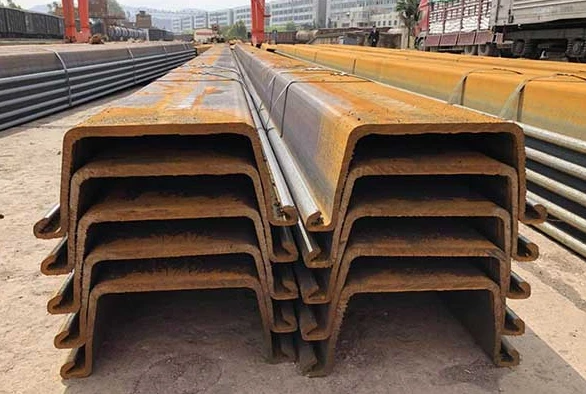
A cofferdam is a temporary or permanent water-excluding enclosure that holds back soil and water so that foundations, bridge piers, or sub-structures can be built in the dry. The U-type steel sheet pile - also known as a Larssen or U-pile - is a hot-rolled steel section whose symmetrical "U" web interlocks with adjacent piles along its edges. When a series of these piles is driven in sequence, the interlocking profilers lock into one continuous wall that resists lateral soil pressure and water flow.
Compared with Z-type and straight-web sections, the U-profile is especially well suited to circular and curved geometry. Its balanced section modulus lets contractors form circular cells and arched retaining walls without complex bending or fabrication of corner units. Nucor Skyline notes that sheet piling is valued in construction precisely for its durability, strength, and versatility across multiple applications; the interlock is the load path that determines performance, and hot-rolled U-piles are prized for a tight, dependable water seal.
Key Properties That Make U-Sheet Piles Suit Cofferdams
Four engineering properties explain why U-piles are a first-line choice for cofferdam work.
Watertightness through a well-proven interlock
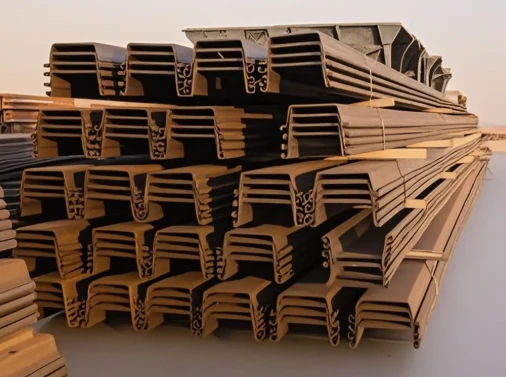
The interlock is the heart of a cofferdam. U-piles rely on proven hot-rolled Larssen interlocks whose clearance is designed to balance two demands - free-driving ease and a reliable seal.
High bending stiffness and section modulus
A U-pile wall must resist large bending moments from earth and water pressure. A higher section modulus means less deflection for a given load. Standard U-sections deliver an elastic section modulus in the range of roughly 874 to 3,820 cm³/m per metre of wall, letting designers pick the most economical section for the required depth and load.
Good driving properties and lightweight handling
The symmetrical profile and moderate mass make U-piles comparatively light and easy to handle, drive, and interlock on site. This directly shortens installation time and trims equipment and labour cost.
Reusability and circularity
Because a temporary cofferdam is decommissioned once the structure is complete, the piles can be extracted, re-treated, and reused on the next project. Steel is infinitely recyclable, and any pile at the end of its service life returns to the mill as scrap and is remelted into new sections.
Circular Cofferdams - The Signature U-Pile Application
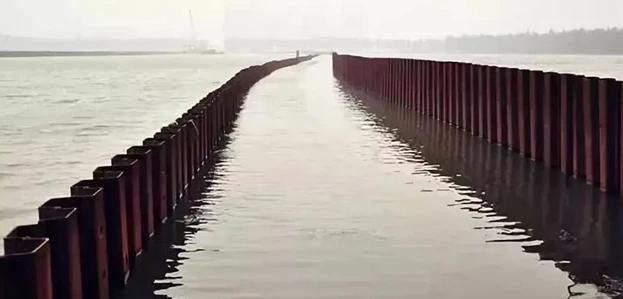
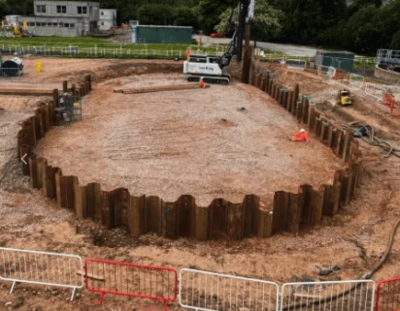
The defining application of U-type steel sheet piles is the circular (or cellular) cofferdam. Because the U-profile bends easily into a continuous arc, contractors can enclose a round dry-dock area - typically around a bridge pier or in-water structure - without welding special corner sections. The piles act in tension through their interlocks at the circumference, allowing large-diameter cells to carry considerable water pressure while remaining a single, self-supporting ring.
Typical examples include:
Bridge pier cofferdams - dry-working enclosures in rivers and marine environments before pier and foundation construction.
Quay wall and dock construction - temporary or permanent retaining cells for port infrastructure.
Breakwaters and seawalls - curved water-defense walls where the U-profile follows the alignment.


Other Cofferdam and Trench Applications
Beyond the circular cell, U-piles serve a broad range of water and soil-retention roles:
Deep excavation support - retaining walls for basements and shafts, often with an internal bracing or tie-back system.
Trench and pipeline shoring - temporary walls that keep excavation sides stable during utility and pipe work.
Riverbank and canal lining - restraint and erosion protection along watercourses.
Flood defense and cut-off walls - impermeable barriers that contain water or pollution in environmental and reclamation schemes.
In all these cases the walls transfer the lateral pressure from the high side of the wall to the soil in front, stabilizing the excavation and keeping the working area dry or stable.

Temporary vs. Permanent Cofferdam Design
Specifiers should decide at design stage whether the cofferdam is temporary or permanent, because it changes the grade, corrosion protection, and reuse strategy.
Temporary cofferdams
Temporary systems prioritize speed and recovery. Piles are driven, braced, and extracted after the concrete structure is cast. Their value lies in being reusable: the same sections move from site to site, which is why standard hot-rolled U-series designed for repeated use have strong market acceptance.
Permanent cofferdams
Permanent solutions keep the piling as part of the finished structure - for example, a sheet-pile wall that also serves as the permanent foundation wall of a basement. This removes the need for a separate concrete retaining wall within a shored excavation, cutting construction schedule and total cost. Permanent walls may use corrosion-resistant grades such as ASTM A690 in marine environments, reducing long-term maintenance.
Steel Grades, Standards and Section Selection
Correct section selection balances depth, load, and economy. The three most common series - PU, AU, and GU - are produced to international standards and deliver a range of section moduli.
| Parameter | Typical Values / Options |
|---|---|
| Section series | PU / AU / GU (e.g., PU12, PU18, AU14, AU20, GU22N) |
| Steel grades | S270GP, S355GP, S390GP (EN 10248); ASTM A572, A690; JS S & equivalents |
| Production standards | EN 10248 (hot-rolled), JIS A 5528, ASTM A328/A690 |
| Single-pile width | 400 – 750 mm |
| Wall depth (web height) | 200 – 500 mm |
| Thickness | 8 – 24 mm |
| Section modulus (Z) | roughly 874 – 3,820 cm³/m typical |
| Interlock type | Hot-rolled Larssen or equivalent; optional corner/clutch bars for closed enclosures |
| Standard lengths | 6, 9, 12, 15, 18, 24 m; longer via welding |
Selecting a section is a design exercise: pick the smallest section whose section modulus resists the design bending moment, then confirm drivability for the soil. A heavier, high-grade section at S355–S490 can reduce the number of piles where ground is hard, while thinner high-strength steel carries more load per unit weight.
Below are reference dimensions and section properties for common PU, AU, and GU U-piles. Metric values are indicative for initial selection; the final section must be confirmed against the project's design loads and the relevant mill certificate.
| Series | Section | Width B (mm) | Wall Depth H (mm) | Mass (kg/m) | Section Modulus (cm³/m) |
|---|---|---|---|---|---|
| AU | AU14 | 750 | 408 | 77.9 | 1 405 |
| AU16 | 750 | 411 | 86.3 | 1 600 | |
| AU18 | 750 | 441 | 88.5 | 1 780 | |
| AU20 | 750 | 444 | 96.9 | 2 000 | |
| AU23 | 750 | 447 | 102.1 | 2 270 | |
| AU25 | 750 | 450 | 110.4 | 2 500 | |
| PU | PU12 | 600 | 360 | 66.1 | 1 200 |
| PU18 | 600 | 430 | 76.9 | 1 800 | |
| PU22 | 600 | 450 | 86.1 | 2 200 | |
| PU28 | 600 | 454 | 101.8 | 2 840 | |
| PU32 | 600 | 452 | 114.1 | 3 200 | |
| GU | GU 7N | 600 | 310 | 44.1 | 675 |
| GU 12N | 600 | 320 | 64.6 | 1 200 | |
| GU 16N | 600 | 430 | 72.6 | 1 670 | |
| GU 22N | 600 | 450 | 86.1 | 2 200 | |
| GU 28N | 600 | 454 | 101.8 | 2 840 | |
| GU 32N | 600 | 452 | 114.1 | 3 200 |

Installation and Driving Methods
The way U-piles are installed affects speed, noise, and site conditions. The three mainstream methods are:
Vibration driving - fast and effective in loose to medium soils; commonly used for temporary walls and where installation speed matters.
Impact driving - a drop or diesel hammer for hard ground and stiff soils, delivering the penetration force that vibration may lack.
Hydraulic pressing - low-noise, vibration-free installation, ideal in urban or sensitive areas near existing structures.
For a fully enclosed cofferdam, designers add corner sections and clutch bars that lock walls together into a closed ring, improving retention of water and fine material. Layout and interlock compliance follow the guidance of EN 12063, which covers the design of sheet-pile structures. Many suppliers also run cofferdam configuration software to calculate exact cell dimensions before piling starts.
Conclusion
U-type steel sheet piles deliver a rare combination for cofferdam work - a watertight interlocking wall that is fast to install, easy to bend into circular cells, reusable after extraction, and available in a flexible range of sections and grades. Whether you need a temporary bridge-pier enclosure or a permanent retaining structure, the U-pile is a proven, cost-effective solution that holds soil and water back so the real construction can begin.
Contact now to get U-type steel sheet piles
FAQ:
What is the difference between a U-type and a Z-type sheet pile?
U-piles have a symmetric profile that interlock into straight lines or gentle curves, which makes them ideal for circular cofferdams and curved walls. Z-piles offer an even higher strength-to-weight ratio for straight, high bending moment walls, but they are harder to bend into a circle. For cofferdam cells that enclose a round area, U-piles are the practical choice.
Can the same U-pile cofferdam be used for temporary and permanent structures?
Yes, the same sections serve both roles - the difference is in design intent. A temporary cofferdam prioritises quick installation and clean extraction so the piles can be reused. A permanent solution keeps the wall as part of the finished structure and often uses corrosion-resistant grades such as ASTM A690 to extend service life with less maintenance.
Why are U-piles preferred for circular cofferdams?
Because the U-profile bends naturally into a continuous arc, contractors can form a large circular cell without welding special corner sections. The piles work in tension through their interlocks around the circumference, so the finished ring is self-supporting and carries water pressure efficiently.
How do I choose the right U-pile section for my project?
Select the smallest section whose section modulus resists the design bending moment for the required wall depth, then confirm drivability for the ground conditions. Reference tables for PU, AU, and GU series give the width, depth, mass, and section modulus to compare options. The final choice should be confirmed against the mill certificate and production standard.
How long can a U-sheet pile be supplied?
Standard lengths range from 6 m to 24 m. Where a project needs a longer pile, sections can be welded together during fabrication to reach the required length. Planned joints are positioned to avoid the high-stress zones of the wall.
How are temporary U-sheet piles removed and reused?
After the concrete structure is complete, the piles are extracted with vibratory or impact pullers, cleaned, and re-treated for the next project. At the end of their usable life, they are sold as scrap and remelted into new steel, so nothing goes to landfill.