

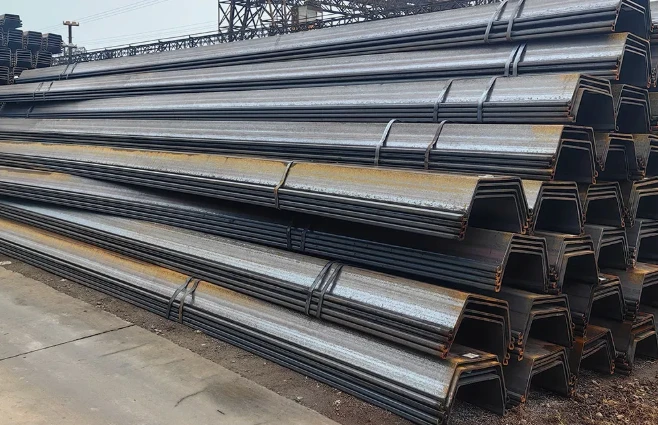
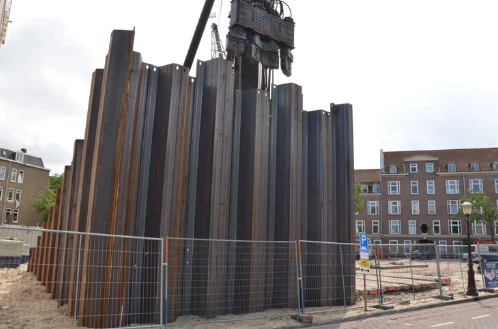
U-type steel sheet pile is a hot-rolled steel section with a symmetrical U-shaped profile; adjacent piles interlock at their edges to form a continuous earth- and water-retaining wall. Its construction method centers on the technique of driving the piles smoothly and safely to the design depth, and is mainly divided into three categories - vibratory, impact, and static-press - supplemented by such supporting operations as guide-frame positioning, interlock cleaning and lubrication, driving sequence, and land-based or underwater work.
What Is a U-Type Steel Sheet Pile?
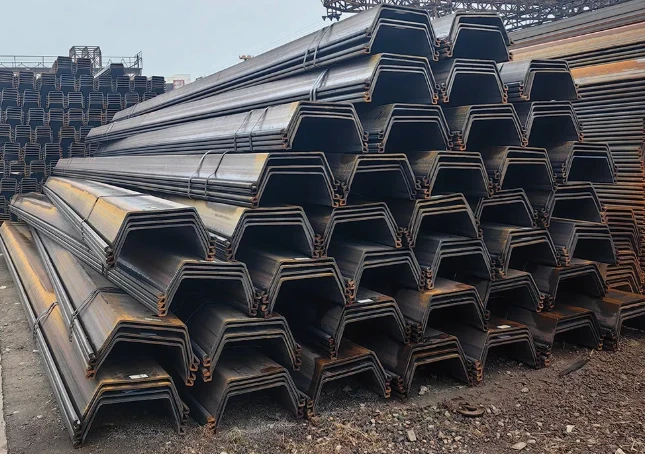
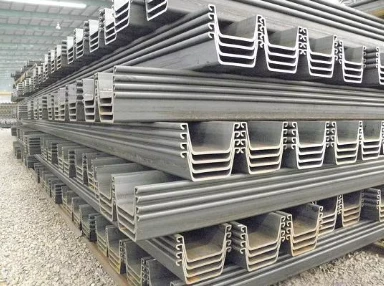
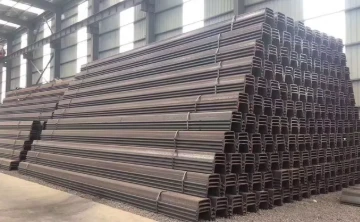
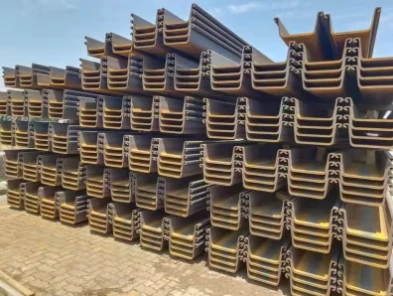
U-type steel sheet pile is a hot-rolled (or cold-formed) steel section with a symmetrical U-shaped profile. Along its two edge flanges runs a formed interlock extending the full length of the pile on each side. When one pile is set beside the next, the interlocks engage; as the piles are driven one by one, adjacent piles are linked by the interlocks into a continuous wall, and seepage is sealed at the watertight interlocks.
The open U-shape gives the section its stiffness - delivering a high section modulus at equal weight - so the completed wall carries lateral earth and water pressure, while the section's width and depth determine how much thrust each pile takes.
U-type sheet piles are defined by width, section depth, plate thickness, and pile length, and are supplied to GB/T 20933, EN 10248, JIS A 5528, or ASTM, with steel grades ranging from Q295P and S240GP to Q460P and S500GP. Common sections are about 400 to 600 mm wide and 100 to 215 mm deep; where a longer run is needed, the piles are extended by splicing within the wall.
Characteristics of U-Type Sheet-Pile Construction
The right method is a trade of ground, site, and regulation; the decision rests on several points:
Ground and pile length. Soft and sandy ground suits vibration; stiff and very dense strata may demand impact; press-in suits soft-to-medium ground that still gives an adequate reaction.
Site and air-space. Headroom, working footprint, and whether the line runs beside rail, road, or a working structure narrow the equipment that can be used.
Noise and vibration limits. Urban and amenity sites set strict limits, which direct the choice toward low-noise, low-vibration (press-in or high-frequency resonant-free vibratory) methods.
Underwater or land. Overland lines use tracked rigs and cranes; underwater profiles need floating plant and a guide frame held from above.
Programme and durability. Speed-to-market and the number of piles weigh on the method, as does the need to retrieve temporary piles cleanly afterwards.
Factors That Decide the Method
The right method is a trade of ground, site, and regulation; the decision rests on several points:
Ground and pile length. Soft and sandy ground suits vibration; stiff and very dense strata may demand impact; press-in suits soft-to-medium ground that still gives an adequate reaction.
Site and air-space. Headroom, working footprint, and whether the line runs beside rail, road, or a working structure narrow the equipment that can be used.
Noise and vibration limits. Urban and amenity sites set strict limits, which direct the choice toward low-noise, low-vibration (press-in or high-frequency resonant-free vibratory) methods.
Underwater or land. Overland lines use tracked rigs and cranes; underwater profiles need floating plant and a guide frame held from above.
Programme and durability. Speed-to-market and the number of piles weigh on the method, as does the need to retrieve temporary piles cleanly afterwards.
Driving Methods of U-Type Sheet Piles
Vibratory Hammer Method
Principle and Equipment: a vibratory driver at the pile head sets the soil-water system into vibration; amplitude and frequency are matched to the pile and ground conditions.
Suitable for: sand, saturated soft soil, and fill, where vibration takes effect quickly; it is the most common method for temporary works and straight runs.
Limitations: effectiveness drops in hard, dense, or cohesive soils, and vibration alone may fail to drive the pile to depth.
Impact Hammer Method
Principle and Equipment: a diesel or hydraulic hammer drops a heavy ram onto the anvil and pile head; blow energy, frequency, and stroke are controlled to avoid damaging the pile.
Suitable for: stiff clay, dense gravel, cobble layers, or highly weathered rock, and wherever penetration through hard strata is required.
Limitations: it is the noisiest and most vibratory of the three methods, so neighboring structures and sensitive soils must be protected; a cushion is fitted at the pile head to protect the interlocks.
Static-Press Method
Principle and Equipment: a static-piling press grips the new pile and applies a steady vertical force, using the reaction from previously driven piles as its support; advanced models add slight vibration in harder soil.
Suitable for: soft to medium-hard soil, and urban, rail, sensitive, or in-service-structure sites with strict noise and vibration limits - where the quietest method is required.
Limitations: it needs the already-driven piles to provide reliable reaction, may struggle in hard or boulder-bearing strata, and the equipment is more costly.
Method Selection Comparison
| Method | Principle | Best ground | Noise / vibration | Nearby structures | Character |
|---|---|---|---|---|---|
| Vibratory hammer | High-frequency vibration fluidises soil, pile sinks | Sand, soft ground, backfill | Moderate to low (resonant-free lower) | Low; usable in sensitive areas | Fast, economical, widely used |
| Impact hammer | Falling ram energy drives the pile | Hard clay, dense gravel, weathered rock | High | High; cushion and controls needed | Strongest penetration, very adaptable |
| Press-in | Steady jacking using driven piles as reaction | Soft to medium ground, strict sites | Very low | Very low | Quietest, precise, higher plant cost |
Note:a mixed approach is common - a vibratory hammer for the bulk, an impact hammer to clear a hard seam, or press-in where a dam or a live line leaves no margin. The method is decided for the site, then confirmed against trial piles.
Supporting Piling Operations
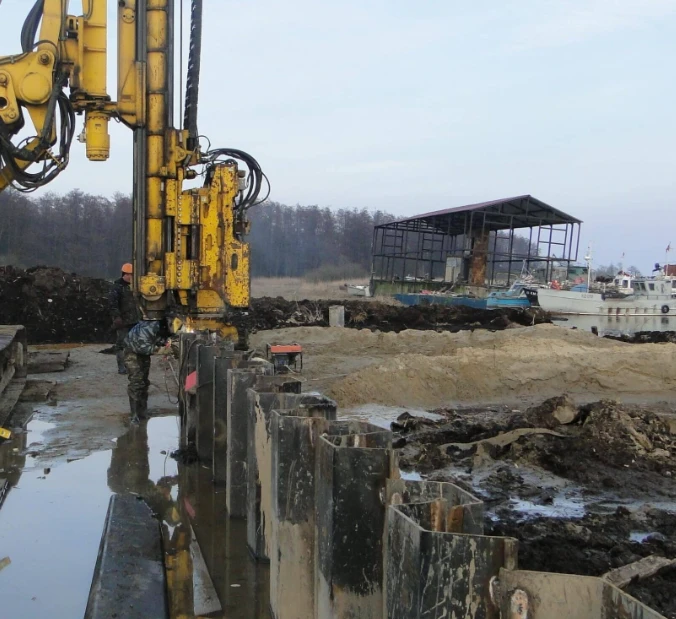
Alignment. A guide frame or template holds every pile plumb and on line as it is pitched, keeping the wall straight and the locks engaged edge to edge.
Interlock care. Locks are cleaned and lubricated before driving so neighbouring piles sit close and the seal stays; a damaged lock is dressed before it meets the next pile.
Driving sequence. Piles are advanced in a planned order - leading, intermediate, and corner piles - to control drift and keep cumulative offset within limits.
Extension. Where a pile must pass the available length, sections are spliced with plates and welds that restore the full section and the lock where extended.
Underwater driving. From floating plant, piles are pitched into a submerged guide and driven with an underwater hammer or a vibratory rig, the toe and seams kept watertight.
Extraction and Reuse
Temporary U-piles are retrieved once the works are complete, keeping the ground reusable and the steel recoverable.
Extraction. A vibratory extractor or a press-in puller lifts the pile back out in the reverse of driving, breaking the toe suction and the ground grip cleanly.
Inspection and recovery. Each extracted pile is checked for lock and section damage, straightened and restored where necessary, and returned for reuse or recycling after the job.
Purpose of careful driving. A calm driving method pays again at extraction: the less the lock is stressed in driving, the more cleanly the pile comes out and the more times a section can serve.
Conclusion
We supply U-type steel sheet piles for the methods described above - rolled to GB/T 20933, EN 10248, JIS A 5528, or ASTM in the section, steel grade, and length your run requires, with interlock surface treatment matched to the driving method and the medium involved. Tell us the section, steel grade, length, and method you plan to use, and we will confirm the corresponding supply.
Contact now to get U-type steel sheet pile
FAQ:
When is vibratory, impact, or press-in used?
Vibratory suits sand, soft ground, and backfill and is fast and economical; impact carries the pile through hard clay, dense gravel, and weathered rock; press-in suits soft-to-medium ground under strict noise and vibration limits. The method is chosen for the site and confirmed against trial piles.
How is lock damage or opening avoided?
Locks are cleaned and lubricated, piles are pitched plumb into a guide, and driving energy is controlled - cushioned in impact - so the lock is not overstressed. Piles are advanced in a planned sequence to keep contact edge to edge.
How are U-piles driven underwater?
From floating plant, piles are pitched into a submerged guide and driven with an underwater hammer or vibratory rig, the toe and seams kept watertight. The driving method and the control of the guide are chosen for the depth and current.
How deep can U-type piles be driven?
Depth is set by the design (penetration for capacity and cut-off for seepage) and reached by the method suited to the ground; several methods can be combined - vibration with an impact finish or press-in in sensitive ground - to carry the pile the full required length.
What do you need to plan a piling operation?
Share the pile section and length, the design depth and target toe, the ground and groundwater profile, the site working space and headroom, any noise or vibration limit, neighbouring services, and whether the line is on land or underwater. With these, the driving method and rig can be specified and jointly checked against trial piles.