

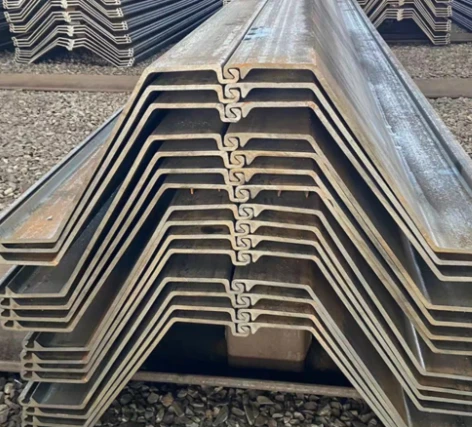
Z-type steel sheet pile is a hot-rolled steel section with a zigzag profile; a formed interlock is provided at each outermost edge of the two ends of the section, and when driven in pairs they link into a continuous wall that retains both soil and water. They suit deep-excavation support because their geometry maximizes bending strength and structural stiffness while minimizing material weight.
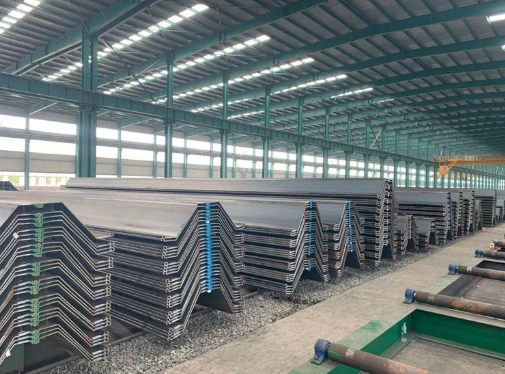
What Is a Z-Shaped Steel Sheet Pile?
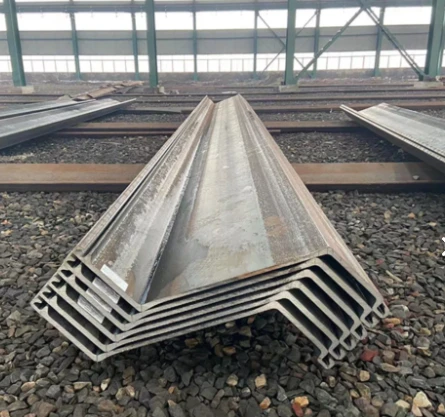
Z-type steel sheet pile is a hot-rolled steel section whose profile extends in a zigzag, with a formed interlock at each of its two outermost ends. The piles are driven as paired sections, and adjacent pairs engage through the interlocks so the whole wall ties into a continuous face.
Because the interlocks sit at the outermost edges of the section, away from the neutral axis, they serve both as the structural connection and as carrying a large share of the bending action.
The section is named by width and wall height under the AZ or JZ system (such as AZ18-700), and is supplied in a range of hot-rolled thicknesses so the section modulus rises with wall height and web thickness.
Why Choose Z-Shaped Sheet Piles for Deep Excavation Support?
A deep excavation asks its wall to resist the earth and water pressure of a tall cut. The Z section answers that demand with a combination of stiffness, load transfer and material economy:
High section modulus and moment of inertia. The corrugated depth of the Z profile gives a large section modulus per unit mass, so a taller or stiffer wall is achieved without proportionally heavier sections.
Efficient interlocks at the extreme fibres. Locating the interlocks far from the neutral axis lets a Z wall transfer a higher proportion of the applied load to the soil, raising the effective load-carrying capacity of the wall for the same steel.
Lighter wall at equal capacity. For a similar section modulus, the mass per square metre of a Z wall is below that of a U wall, which cuts tonnage, transport and handling.
Wider panels, faster driving. Large panel widths reduce the number of drives and the total lifting and piling time on site.
These properties make the Z profile the usual choice where a deep excavation demands a large section modulus - the alternative being a heavier U wall of the same capacity, or a pipe-combi system for the deepest cuts.
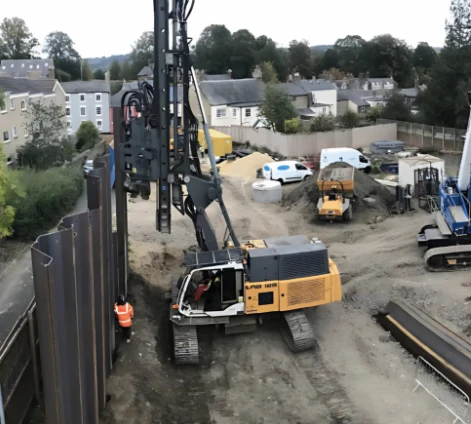
Interlock Efficiency and Watertightness in Excavation Support
In an excavation-support wall the interlock of a Z pile is where the wall carries its load and keeps water out. Because it sits at the extreme end of the section, far from the neutral axis, it hands a higher share of the ground and water pressure to the soil - the reason a Z wall stays efficient as the retained height grows.
| Function of the interlock | How it works | Significance in a deep cut |
|---|---|---|
| Structural connection | Closes each pile to its neighbour so panels build into a continuous run | Keeps the wall acting together under bending rather than as separate leaves |
| Load transfer | Sits at the extreme fibres, far from the neutral axis, handing the load to the soil | Raises effective capacity for the same steel, as the depth increases |
| Water sealing | Engages against the next interlock to block ground-water passage | Limits seepage into the cut where it meets the water table |
Support Systems of Z-Shaped Steel Sheet Piles Excavation Support
A single Z pile wall does not suit every depth; the system built around it scales with the retained height. Three arrangements cover the normal range of deep excavations:
| System | Typical depth | Principle |
|---|---|---|
| Cantilever wall | Shallow to moderate | The free Z wall carries the full earth and water pressure by embedment in the ground, with no external restraint above the cut. |
| Anchored wall | Moderate to deep | Wales distribute the load to tie rods or ground anchors that hold the wall head or face, cutting the bending moment the wall must resist. |
| Pipe-combi wall | Deep, high moment | Steel pipe or H main piles carry the bending while Z sections close the panel between them - a very high composite section modulus for the deepest cuts. |
Moving from cantilever to anchored to pipe-combi trades section weight against restraint. For a deep excavation, anchoring the wall head is often more economical than increasing the Z section, while a pipe-combi wall is reserved for the largest depths and moments where Z sections alone cannot carry the load.
How to Choose the Right Section-Size?
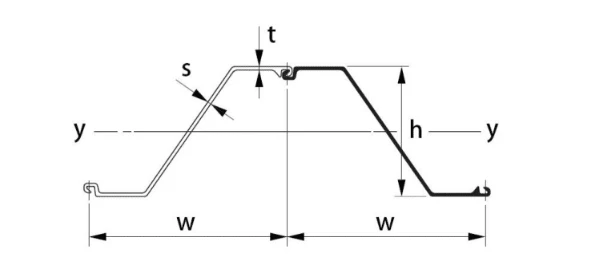
Selection starts from the excavation: shallow digs are handled by smaller AZ sections; as depth increases, the section modulus must rise accordingly - either by moving to a larger AZ section or by adopting a combined system. The table below lists representative Z (AZ) sections and their section moduli; the exact choice must be confirmed against the wall's earth pressure and the applicable execution standard.
| Section | Width b (mm) | Height h (mm) | Thickness t (mm) | Wall mass (kg/m²) | Section modulus W (cm³/m) |
|---|---|---|---|---|---|
| AZ12-700 | 700 | 314 | 8.5 | 96.7 | 1205 |
| AZ14-700 | 700 | 316 | 10.5 | 114.7 | 1405 |
| AZ18 | 630 | 380 | 9.5 | 118 | 1800 |
| AZ18-700 | 700 | 420 | 9.0 | 109 | 1800 |
| AZ24-700 | 700 | 459 | 11.2 | 136 | 2430 |
| AZ26-700 | 700 | 460 | 12.2 | 147 | 2600 |
| AZ36-700N | 700 | 499 | 15.0 | 169 | 3590 |
| AZ38-700N | 700 | 500 | 16.0 | 181 | 3795 |
| AZ46 | 580 | 481 | 18.0 | 229 | 4595 |
| AZ50 | 580 | 483 | 20.0 | 253 | 5015 |
Steel Grades and Standards for Z Piles
Z steel sheet piles are supplied hot-rolled against one of the major sheet-pile standards, with grades chosen for the yield strength the excavation demands. Higher grades give a higher allowable stress for the same section, so they are selected as the retained height grows.
| Standard | Grades |
|---|---|
| EN 10248 (hot-rolled) | S235GP, S275GP, S355GP, S390GP |
| JIS A 5528 | SYP, SY295, SY390 |
| GB/T 20933 | Q295P, Q345P, Q390P, Q420P, Q460P |
Note:grade correspondence varies across standards; confirm the yield strength and chemical composition of the supplied heat on the mill certificate.
Installation Method of Z-Shaped Steel Sheet Piles
For excavation support, the Z piles are placed first, forming the retaining wall around the cut before the digging starts; the installation method is chosen by the ground and the site.
| Driving method | Suitable ground | Remarks |
|---|---|---|
| Vibratory hammer | Loose to medium (sand, silt, soft clay) | Fast placement, also used at extraction |
| Press-in rig | Soft to medium, sensitive or confined sites | Low noise and vibration, good near structures |
| Impact hammer | Dense or hard strata | Higher driving force, often combined with jetting |
| Water jetting | Dense sand/gravel or hard clay | Reduces driving resistance, combined with the above |
Z-type steel sheet piles meet deep excavation with a wall that is strong, watertight, and steel-efficient. As a sheet-pile supplier, we supply Z (AZ) sheet piles in the section and grade required by your execution standard - rolled to specification with a mill certificate, surface and interlock treatment matched to your driving and extraction method, and advice provided on the support system, section, and reuse.
Send us your excavation depth, wall support, and geotechnical data for a section recommendation and quotation, or contact our team to match a Z-section to your project.
Contact now to get Z-type steel sheet piles
FAQ:
How is a Z-section chosen for an excavation?
Provide the excavation depth, water level, soil data and any internal or external support; these return the bending moment and the required section modulus, from which the AZ section (or a pipe-combi system) is confirmed.
When should Z piles be chosen over U piles?
Z piles win on section efficiency: for a similar section modulus the Z wall is lighter and transfers load more efficiently, so deep excavations usually prefer Z. U piles remain common for shallower or sheeting-type duties and where supply is established.
What are the depth and ground limits?
Very soft or fine ground is met by deeper embedment and a higher grade; rock or dense gravel that resists driving may require pre-drilling or an alternative support method.
Do you provide selection and design support?
Yes. As a Z sheet pile supplier we recommend the section, steel grade, pile length and support arrangement from your excavation data and confirm mill certificates; the formal structural calculation is done by the designer, to whom we supply the section parameters.
How are supply and lead time arranged?
We supply against the section and grade of the chosen standard, with quantity worked out from the wall length and depth and lengths made up to the excavation height; once depth, section, tonnage and required date are set, we give the production or delivery plan.