

U-type steel sheet pile is a hot-rolled steel section with a symmetrical U-shaped profile; adjacent piles interlock at their edges to form a continuous wall that retains both soil and water and cuts off seepage. Used in canal lining, its interlocking U-shaped design provides excellent watertightness and lateral soil retention while shortening installation time and reducing overall project cost.

What Is a U-Type Steel Sheet Pile?
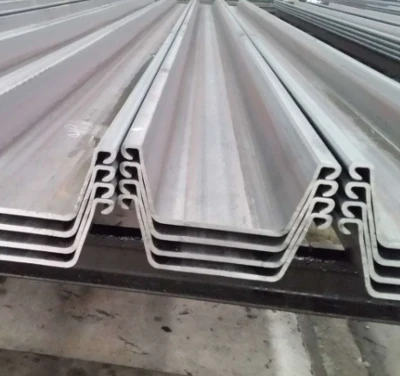
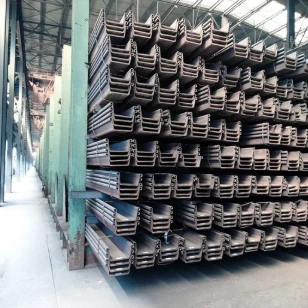
U-type steel sheet pile is a hot-rolled sheet-pile section and the basic unit of a steel continuous wall. Its profile is a slender, symmetrical U-shape, with a formed interlock along each of its two vertical edges. When the piles are driven side by side, adjacent piles close through the engaged interlocks into a continuous wall.
The pile is supplied to GB/T 20933, EN 10248, and JIS A 5528, in the system-corresponding steel grades (such as Q355P, S355GP, SY390) and in the section and pile length selected by head and wall depth: the section determines the required section modulus, the grade determines the earth and water pressure the wall can carry, and the pile length is extended to suit the slope height.
U-type steel sheet piles are supplied in standard sections, where combinations of width, height, and web thickness yield different section moduli to suit varying wall depths and heads. The table below shows typical U-type sections:
| Section | Width S (mm) | Height h (mm) | Thickness t (mm) | Wall mass (kg/m²) | Section modulus W (cm³/m) |
|---|---|---|---|---|---|
| Type II | 400 | 100 | 10.5 | 48.7 | 366 |
| Type III | 400 | 125 | 13.0 | 60.4 | 509 |
| Type IV | 400 | 170 | 15.5 | 76.0 | 894 |
| Type V | 500 | 200 | 24.3 | 105.0 | 1510 |
Note:Exact dimensions and section moduli depend on the edition of the governing standard; confirm them in the standard's section handbook when quoting.

Why U-Type Steel Sheet Piles Are Used for Canal Lining?
Unlined channels lose water to seepage around their perimeter and are scoured by the moving flow. A sheet-pile lining directly addresses both:
Seepage control.A driven steel wall tied in with watertight interlocks blocks the seepage paths along the banks, reducing the water infiltrating adjacent soil strata and improving conveyance efficiency.
Bank and cross-Section Stability.The vertical wall stabilizes the slopes and fixes the channel cross-section, keeping the design water level and flow area consistent season after season.
Withstanding head differential.As a continuously loaded wall, it stays stable even where the lining must rise above the surrounding ground and carry the head differential and earth pressure created by the channel.
Durable and low-maintenance.The steel lining needs no curing and, unlike rigid linings, does not crack readily, carrying the channel's conveyance life under routine inspection.

Typical Lining Arrangements of U-Type Steel Sheet Piles
U-type piles are placed around the channel where sealing and reinforcement are needed. The main arrangements are:
Sidewall Lining. Walls set along one bank or both stabilize the slopes and seal the seepage paths on the lined side.
Closed Lining Cross-Section. Side walls joined with channel-bottom treatment form a continuous closed section, achieving full-perimeter seepage control on fully lined channels.
Localized Reinforcement. Targeted steel facing at eroded or head-concentrated sections, such as bends or weak-subgrade reaches.
Transition Sections. At the junctions between steel lining and culverts, lock chambers, or adjacent concrete lining, sealed joints and seepage cutoff are provided.
Lining and Seepage-Control Design
Lining and seepage-control design begins with the channel cross-section, design water level, and the head the wall must carry, which determine the embedment depth and steel grade. Seepage control is the essence of the lining: interlocks are treated as sealed joints, and cutoff is provided at transitions and joints alike; on fully lined reaches the side walls and channel bottom close into a continuous section, while in weak or fine-grained strata the embedment is deepened so the wall relies on embedment to carry load rather than on a heavier wall top.
| Lining target | Role of the U-type pile | Benefit to the canal |
|---|---|---|
| Seepage control | Watertight interlock seals the seepage path | Lower water loss; higher delivery efficiency |
| Bank and slope stability | Side wall holds the slope and fixes the section | Designed flow area maintained |
| Head difference resistance | Continuous loaded wall takes the head | Operating water level held securely |
| Conveyance life | Durable wall with routine inspection | Reduced maintenance over the service life |
Steel Grades and Standards
The grade is chosen for the load the lining wall must carry, and the section for its depth. Piles are supplied under GB/T 20933, EN 10248 and JIS A 5528, whose grades correspond in yield strength across the systems, so the wall can be specified and quoted against the standard the scheme is drawn to.
| Standard | Examples of grade (yield) | Use in canal lining |
|---|---|---|
| GB/T 20933 | Q235P, Q355P | Linings specified to the Chinese standard |
| EN 10248 | S270GP, S355GP | Linings specified to the European standard |
| JIS A 5528 | SY295, SY390 | Linings specified to the Japanese standard |

Construction of a Steel-Pile Canal Lining
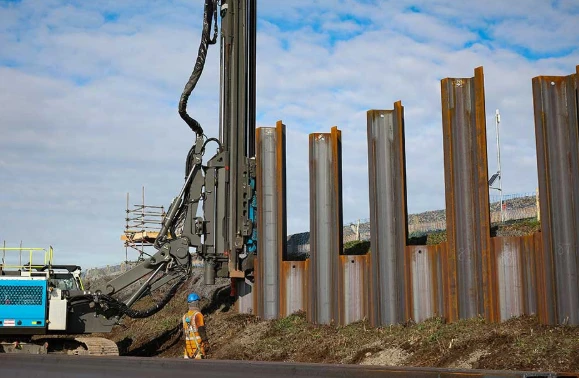
Construction places the piles along the set-out line of each bank, one threaded into the interlock of the next and driven to the design depth, so the reach forms a continuous, watertight wall. Long, straight reaches are driven in panels to keep cumulative deviation within tolerance; the hammer is chosen for the ground and access, and joins to culverts, sluices or adjacent concrete are sealed and given a seepage cut-off in the same campaign.
| Pile element | Role in canal lining | What to confirm |
|---|---|---|
| Section and length | Depth chosen for the retained head; length made up to the slope height | Section and pile length on the quotation |
| Steel grade | Carries the earth and water pressure of the wall | Grade against the governing standard and mill certificate |
| Interlock | Threads and closes into a watertight continuous wall | Fully engaged before driving |
| Surface and interlock finish | Matched to the driving method and the exposed working | Finishing agreed at the order |
As a U-type steel sheet pile supplier, we supply the grade and section the lining requires, rolled to the applicable specification and verified against the mill certificate, with interlock and surface treatment matched to the driving method. If you are planning a sheet-pile canal lining, please provide the wall depth and section, steel grade, execution standard, lining arrangement, and quantity; our team will confirm the piles and supply suited to that channel reach for you.
Contact now to get U-type steel sheet pile
FAQ:
How long does a U-type pile lining last, and will it rust?
The service life of a steel lining depends on the corrosive environment and the wall-thickness margin. Permanent linings can take a protective coating, or a section with extra wall allowance suited to the water and soil; a stated life should be checked against wall thickness and corrosion rate in design, not decided on site.
What ground is it suitable for? Weak ground or a high water table?
This is workable. A steel pile bears through its embedment, so weak or fine-grained ground is met by deeper embedment and a higher grade, and a high water table is exactly where U-type interlock sealing is needed. Settle the section and embedment in design from the ground investigation and wall depth.
Do you provide selection and design support?
Yes. As a U-type sheet pile supplier we can recommend the section, steel grade, pile length and lining arrangement for your canal section, design water level and ground, and verify the mill certificate; the formal structural calculation is done by the designer, and we supply the section parameters and the piles to it.
Does the interlock stay watertight over time, and is maintenance needed?
Once built, the wall keeps its watertightness through the engagement and sealing of the interlocks; routine inspection checks the joints and the wall toe in service. Ensuring full interlock engagement during driving is the condition for long-term sealing.
How are supply and lead time arranged?
We produce or supply against the section and grade of the chosen standard, with the quantity worked out from the reach length and wall depth, and pile lengths made up to the slope height. Once the wall depth, section, tonnage and required date are set, we give the production or delivery plan; for urgent works, lock the sizes and quantity as early as possible.