



Our high-strength steel pipe trusses carry large-span roofs through a triangular lattice of smooth round tubes joined by CNC-profiled, full-rigid welded nodes. Branch ends are machine-cut to the chord profile and welded directly, so the joint needs no gusset plate, keeps the flow of load clean and gives the truss a crisp, regular look. Because it works largely in axial force, the lattice stays light over long clear spans, while the round sections resist torsion well and lower wind drag on exposed roofs.
Trusses are prefabricated in factory-welded segments and only spliced on site with end flanges and high-strength bolts - no main field welding. We deliver one-stop: Tekla detailing to your drawings, CNC profiling and cutting, automatic welding, quality inspection, shot blasting and coating, then seaworthy segmented export packing - quoted within 24 hours.

Engineering Performance & Design Notes
This section explains how the pipe truss resists roof loads and how its welded nodes are checked, so you can specify it with confidence.
Triangular lattice efficiency - bending is resolved into member axial forces, cutting dead weight and foundation cost vs a solid beam at equal load.
Full-rigid welded node - the profiled branch weld transfers moment and shear directly to the chord with no gusset plate and a clean, regular profile.
Low-drag, torsion-strong section - round tubes cut wind load on exposed roofs and offer better torsional resistance than open sections.
Wind & seismic capacity - engineered to 200 km/h wind (Z=2) and earthquake degree 4, with live 50 kg/m² and dust 10 kg/m² loads.
Field splice without site welding - factory segments meet through end flanges and high-strength bolts, keeping site welding to a minimum.
Detailing - Tekla 3D model issues fabrication, node and erection drawings.
Applicable design standards: GB 50017 · GB 50009 (Load Code) · AISC 360 / EN 1993-1-1 as selected per target market.

Specification of Steel Pipe Truss
| Structure Type | Steel Pipe Truss |
| Tube | Steel Q235B,Epoxy zinc primer with PU paint |
| Purlin | Q235B, galvanizd C section steel with two coats painting |
| Roof &Wall Panel | V-760 double-layer color steel plate clip glass silk cotton (0.5mm+75mm+0.4mm),V760 0.5mm dip aluminum-zinc steel sheet + Glasswool Blanket with Aluminum-foil paper+ Wire Mesh,Single dip aluminum-zinc steel sheet |
| Skylight Sheet | V-760, 1.2mm / V-900, 1.0mm / V-780, 1.2mm |
| Sleeve | Steel Q235 & #45,Electro-galvanization |
| Bolt ball | Steel #45, Epoxy zinc primer with PU paint |
| Door | EPS sandwich panel sliding door, Roll door option |
| Shape | customize |
| Wind load | 2(200kph) |
| Earthquake Load | 4(Z=4) |
| Live Load | 50Kg/sq.m |
| Dust Load | 10Kg/sq.m |
| Temperature | +/-30°C |
Core Advantages of Steel Pipe Truss
CNC-profiled full-rigid nodes - branch ends are machine-cut to the chord profile and welded directly, giving a strong, clean joint with no gusset plate.
No main field welding - trusses ship as factory-welded segments and splice on site with end flanges and high-strength bolts.
Light, load-perfect lattice - the triangular void structure works in axial force, saving steel and weight per span versus solid or open-section beams.
Low-drag round tubes - the circular section lowers wind pressure on exposed stadium and coastal roofs and resists torsion well.
Uniform, ready-made look - regular welded nodes and round members give clean lines for architecturally visible roofs and atriums.

Applications of Steel Pipe Truss
Industrial construction - roof support for portal-frame workshops, large-span warehouse roofing, heavy-machinery plant frames and pipe racks.
Commercial & civil buildings - exhibition-center main roofs, sports-arena large spans, open-atrium frameworks and parking-garage top frames.
Transportation infrastructure - airport & station terminal roofs, pedestrian-overpass beams and highway toll-station canopies.
Bridges & viaducts - welded CHS truss beams and approach structures where a strong, light lattice is preferred.
Special engineering - steel mezzanine support, large tank-support trusses, agricultural greenhouses and new-energy plant equipment supports.

Type & Member Selection
| Member | Material / Detail | Function |
|---|---|---|
| Chord tubes (top & bottom) | CHS round tube, Ø per design, Q235B/Q355B | Continuous main members carrying bending as axial force. |
| Web (branch) tubes | CHS round tube, smaller Ø, CNC-profiled end | Triangular web system transfers shear and keeps light weight. |
| Welded node | Branch-end profiled weld (full-rigid) | Direct branch-to-chord weld, no gusset plate. |
| End flange | Plate with pre-drilled high-strength bolt holes | Field splice between factory segments, no site welding. |
| Purlin (kit option) | Q235B galvanized C-section, two-coat painting | Roof secondary member over the truss. |
Installation & Erection Guide
Kit sorting - distribute numbered factory-welded segments against the erection drawing before lifting.
Ground pre-assembly - align the end flanges, torque the high-strength bolts and pre-set any camber on the ground for long spans.
Segment lift & tie - lift with a crane, erect in sequence and tie roof & bracing; torque-check the flange bolted splices before load test.
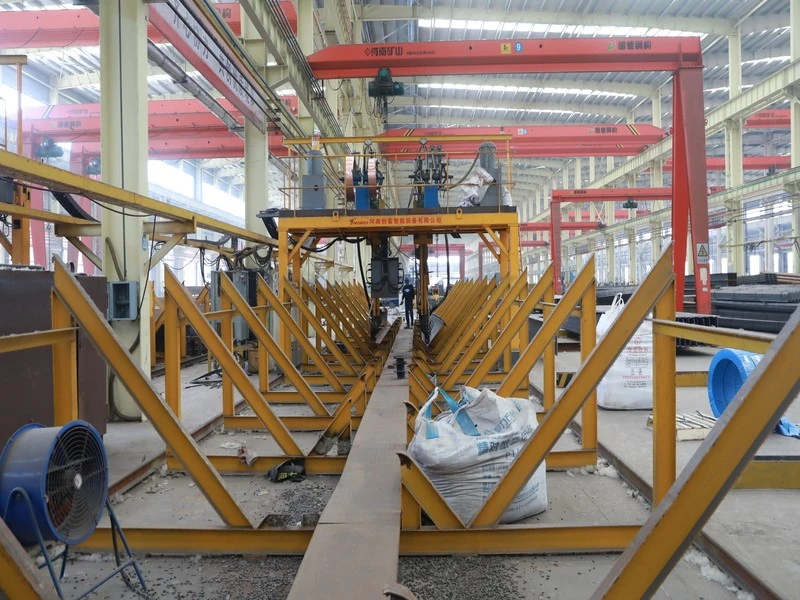
Production Process & Quality Control of Steel Pipe Truss
Production Flow
Material receiving - round tubes verified against MTC for grade, yield and wall thickness.
CNC cutting & profiled node prep - chords cut to length; branch ends CNC-profiled to the chord profile (saddle shape).
Fit-up in jigs - bottom chord aligned, branch tubes positioned to the drawing node angles.
Automatic & hand welding - branch-to-chord weld run along the profiled seam; automatic SAW with hand finishing.
Straightening & end-flange assembly - distortion corrected; flanges drilled and fitted to segment ends.
Blasting & coating - shot-blasted, then epoxy-zinc/GRP coated or galvanized per option; trial-fit segments for splice.




Quality Control
Material verification - Q235B/Q355B chemistry and yield checked against MTC before release.
Weld integrity - 100% UT on critical branch-to-chord welds plus MT, no cracks or porosity.
Profile & splice check - profiled node geometry and flange bolt fit verified on the trial assembly.
Coating & dimension inspection - DFT of primer/topcoat, member and span geometry, with a trial-load check.

Packaging & Shipping
| Item | Detail |
|---|---|
| Packing | Factory-welded segments bundled per bay with padding, lashing and corner protection. |
| Transport | Flat-rack / 40' container engineered loading; anti-rust wrapping for sea freight. |
| Lead time | Typical 30–45 working days. |
| Marking | Piece and flange numbers per bay matching the erection drawing for fast sorting. |
| Docs shipped | Packing list, invoice, mill certificates, NDT reports and erection drawings. |

FAQ:
Why use a welded tubular joint instead of bolted gusset or truss bolted-ball nodes?
The profiled branch end is welded directly to the chord, giving a full-rigid, clean and material-saving joint with no gusset plate; it is the standard choice for large-span permanent roofs where stiffness and aesthetics matter.
How are the prefabricated truss sections joined on site?
Large trusses are split into factory-welded sections and spliced on site with end flanges and high-strength bolts - no main field welding of the members is required.
Are round-tube trusses lighter than H-beam or angle trusses?
A CHS lattice works largely in axial force, so it saves steel and weight per span, while the round section also cuts wind drag and offers better torsional resistance - a good balance for long clear spans.
What corrosion protection is applied to the pipe truss?
Members are shot-blasted and coated - typically epoxy-zinc primer plus topcoat, or hot-dip galvanized for coastal/saline sites - to protect the welded joints and chord surfaces.
How are very long pipe trusses shipped overseas?
They are fabricated in transportable, factory-welded segments that ship on flat racks or in containers, then flanged and bolted together on site using numbered members and an erection drawing.


